Pulled a Superfractor or 1/1? What to Do Next
Pulled a Superfractor or 1/1 sports card? Protect and store it, build a private insurance inventory, preserve damage evidence, and delay irreversible decisions.
Pulled a Superfractor—or another 1/1 sports card? The first job is not to price, grade, sell, or post it. Preserve the card's original condition and the facts of the pull with as little handling as possible. A calm first-hour record gives every later identity, redemption, defect, grading, valuation, evidence, and sale decision better information.
Quick answer
Handle the card only by its edges with clean, dry hands; make one careful front-and-back record over a clean surface; place it in a correctly sized soft sleeve and rigid holder without forcing it; retain the product and pull details privately; and do not clean, press, polish, flatten, or alter anything. Once the card is stable, verify its exact checklist identity before choosing what happens next.
Does this checklist apply to any 1/1 sports card?
The reversible handling, privacy, and pause steps apply to any newly pulled one-of-one collectible card. The identity conclusion does not: a printed 1/1 establishes only a one-copy claim for the identity it marks. It does not make every one-of-one a Superfractor. Only an exact card family supported as the named Superfractor parallel by official product sources can enter this census. Use the 1/1 meaning and Superfractor comparison guide before applying a Superfractor name to another one-of-one.
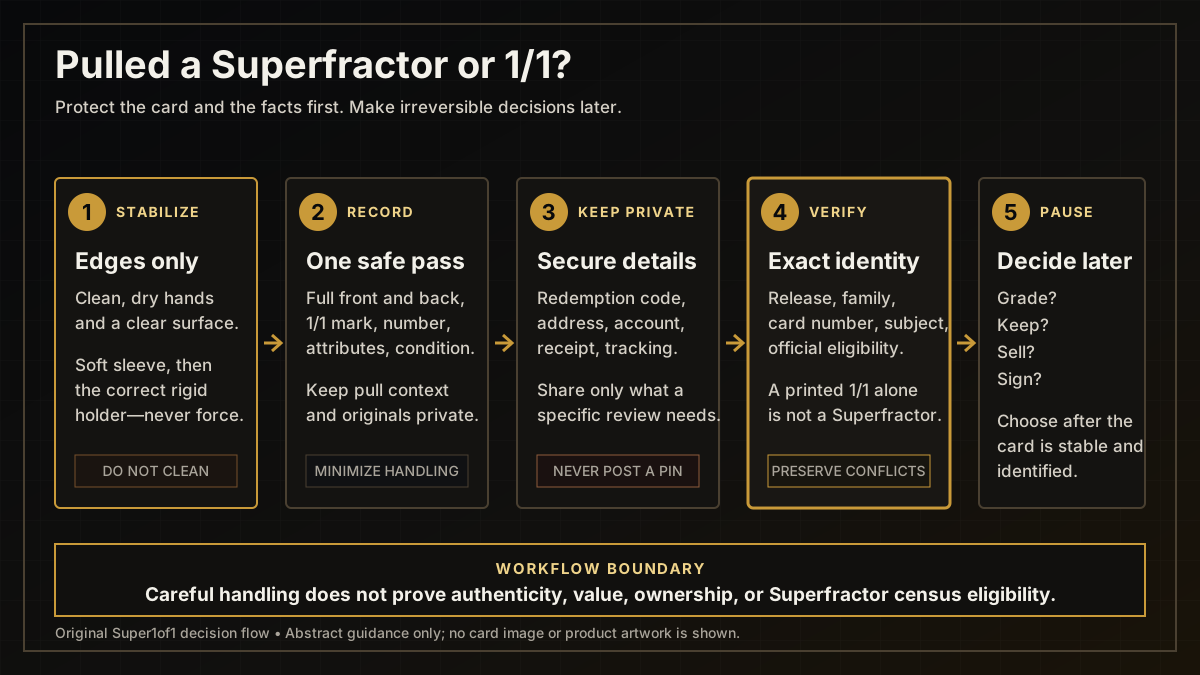
The first-hour Superfractor and 1/1 checklist
| Order | Do now | Do not do yet |
|---|---|---|
| 1. Stop extra handling | Set the card on a clean, dry, uncluttered surface and touch only the edges with clean, dry hands. | Pass it around, stack it with other cards, wipe the surface, or test a corner. |
| 2. Record the original state once | If it can be done safely, capture full front, full back, the 1/1 marking, card number, autograph or relic details, and any visible defect before repeated movement. | Remove a card that is already safely protected only to create a better post or video. |
| 3. Fit the protection | Use a soft sleeve first, then a rigid holder sized for the actual card thickness. Stop if an edge catches or the fit compresses the card. | Force a thick insert, autograph, or relic card into a familiar holder size. |
| 4. Preserve the pull context | Privately record product, configuration, box or pack identifiers, purchase or break source, date, and any accessible original clip or receipt. | Publish an address, order number, redemption code, tracking number, private message, or another person's personal data. |
| 5. Note defects without treating them | Describe and photograph a visible crease, scratch, print line, edge, corner, warp, or surface issue as found. | Clean, press, polish, recolor, flatten, trim, erase, or apply any substance. |
| 6. Pause irreversible decisions | Store the protected card in a secure, cool, dry place away from direct sunlight while identity and options are researched. | Promise a grade, quote a value, accept a rushed offer, add an autograph, or send the card into custody before reviewing the consequences. |
If the pull is a Superfractor redemption
A redemption card is not the completed Superfractor. It is a single-use claim path for a card Topps did not place in the product at release. Treat the covered PIN like a private credential: do not reveal it for a photo, paste it into Super1of1, send it to an unsolicited helper, or enter it anywhere except the official Topps redemption flow.
| Stage | Conservative action | Boundary |
|---|---|---|
| Before revealing the PIN | Record the covered redemption card, printed player or subject, product, card description, pull context, and printed expiration date. Keep the original files private. | A photo that exposes a usable PIN can transfer the claim to whoever redeems it first. |
| Resolve the identity | Compare the printed description with the official checklist and exact-family Superfractor eligibility. Preserve any mismatch instead of borrowing a marketplace title. | The redemption wording alone does not complete a canonical set review or authenticate the eventual card. |
| Check the current rules | Read the Topps Redemption and Authenticity Guarantee terms and Topps redemption support answers before revealing, submitting, mailing, transferring, or valuing the claim. | Validity depends on the applicable product-date policy. Terms, processing estimates, and available remedies can change. |
| Submit and track | If proceeding, use the redemption area of your own Topps account, verify the delivery address, and retain the submission confirmation and status history privately. | Do not treat an account status, estimated window, or another collector's fulfillment as a promise about this claim. |
| If it appears expired or fails | Compare the exact card with both current official date rules below and contact official Topps support when the applicable period or accepted date basis is unclear. | Do not keep guessing at the PIN, mail the card to an address copied from an old post, or rely on a seller's assurance that an expired code will work. |
| Before requesting a substitute | Review the live terms and the exact account options again, then record the decision and response. | Current substitution paths are conditional and discretionary; neither the original card, a particular substitute, a delivery date, nor a value is guaranteed by this guide. |
Is an expired Topps Superfractor redemption still valid?
Do not decide from the printed expiration date alone. As reviewed on 2026-07-16, Topps's controlling terms and its redemption-support FAQ both describe a later-product ten-year rule, but they express the qualifying boundary differently. Record the exact wording instead of silently treating “released,” “dated on the card,” and a printed expiration date as the same field.
| Current official statement | Date basis it uses | Evidence-safe conclusion |
|---|---|---|
| Redemption terms: cards released before January 1, 2022 | The expiration date printed on the redemption card | The current terms say the code must be received or entered by that printed date. |
| Redemption terms: products dated on the card as 2021/2022 or the 2022 season and after | The product date stated on the card | The current terms say those codes are valid for ten total years; preserve the exact date text used to place a card in this group. |
| Redemption-support FAQ: product released on or after January 1, 2022 | The product's release timing | The current FAQ says a ten-year expiration applies despite the printed expiration date and identifies April 29, 2024 as the effective policy date. |
| The card sits near the boundary or the two descriptions produce different answers | Printed card fields, verified product release information, both current official pages, and a dated official support response | Mark validity unresolved and ask Topps through its current support route. The terms state that they control if other information conflicts; Super1of1 does not choose a date basis for Topps. |
| The applicable validity period has actually ended | The period Topps confirms applies to that exact code | The current terms say an expired code cannot be submitted, extended, or redeemed unless the stated later-product rule applies. |
A failed entry does not by itself prove that a code expired. The current terms direct collectors with an unaccepted code to confirm validity with Topps Customer Service before mailing the card. Keep the PIN private, use only the current official account or support route, preserve the dated response, and do not publish account screens, code attempts, support identifiers, or addresses as census evidence.
An unfulfilled redemption never marks the completed canonical card publicly seen. The expected card identity still requires reviewed checklist and eligibility sources, while seen coverage requires an accepted public sighting of the completed exact card, whether from a permitted official API or reviewed independent evidence. A private account screenshot, support message, claim number, or shipping notice is not a public sighting and should not be submitted with personal or security data exposed.
Reusable private redemption record
Record the claim state without copying the PIN into a shared note.
Pull date / source / product / configuration:
Printed player or subject / card description:
Printed product date / expiration date:
Covered front / back record stored privately:
PIN remains covered or is secured outside this note:
Official checklist / eligibility sources reviewed:
Current Topps terms URL / reviewed date:
Date rule wording / card date / release-date source:
Working validity result: within period / expired / conflicting / official confirmation pending
Topps account submission date / confirmation retained:
Delivery address verified privately:
Current account status / observed date:
Support case or mailing proof retained privately:
Completed exact card received / observed date:
Approved independent public evidence source:
Sensitive fields excluded from publication:
Unresolved identity, expiry, or fulfillment question:
Protect the surface before adding rigid support
Topps's current collection-protection guide gives the basic sequence as raw card, soft sleeve, then rigid holder. It explains that direct contact with hard plastic can create surface friction and that holder thickness should match the card. Some Chrome inserts and parallels may need more room than a standard base card, so the safest fit is the one confirmed for the actual stock rather than guessed from the product name.
A soft sleeve protects against surface contact; a properly fitted rigid holder adds support against bending and edge damage. Neither makes the card indestructible. Keep the holder stable, dry, and away from direct sunlight, and avoid repeated removal for inspection, scanning, or social posts.
How to store a Superfractor after the first hour
Choose protection for the exact object and the next task, not for the word “Superfractor” alone. A standard Chrome card, thick autograph, relic, patch, booklet, encased card, and graded card can require different support. Storage, display, grading submission, and shipping are also different jobs: a holder that fits one purpose may conflict with a receiver's current instructions for another.
| Decision | Conservative record or action | What not to assume |
|---|---|---|
| Object and thickness | Record the exact product family, card construction, autograph or relic attributes, current holder, and any confirmed thickness information. Stop when the card catches, bows, rattles, or requires pressure. | A familiar base-card holder fits every parallel, insert, autograph, relic, or multi-layer card. |
| Holder role | Name the immediate purpose—stable storage, display, grading submission, or shipment—and follow the current recipient's instructions before changing an already safe holder. | A magnetic holder, toploader, semi-rigid holder, or slab is universally best for every task. |
| Surface and support | Use a clean soft sleeve before compatible rigid support for a raw card, keep closures and adhesive away from the card, and minimize removal. | Rigid plastic alone prevents abrasion or that repeated handling is harmless. |
| Storage environment | Use a clean, stable, relatively cool and dry location with minimal light, away from direct sunlight, radiators, vents, floor-level leak exposure, and large environmental swings. | A holder makes heat, moisture, flooding, dust, impact, or direct light irrelevant. |
| Display | Review the exact holder's current material and light-protection claims, then reduce exposure and record the display period. | “UV protection” means unlimited direct-sunlight safety or applies equally to the card's foil, ink, autograph, patch, and holder. |
| Periodic review | Compare the protected card and holder with the dated original record without removing the card merely to inspect it. Record cracks, movement, fogging, warping, fading, or other change neutrally. | A later condition change proves when, where, or why it occurred. |
The Library of Congress's care guidance for works on paper supports clean handling, a stable and relatively dry environment, minimal light, distance from radiators and vents, supportive enclosures, and avoiding attics, basements, and other locations with leak or environmental-extreme risk. That is a useful preservation baseline, not a material specification for a modern chromium-finished, autographed, relic, patch, or otherwise composite trading card. If the card or holder shows an unexplained change, preserve the evidence and seek advice qualified for the actual materials rather than applying a treatment.
How to prepare an insurance conversation for a Superfractor or 1/1 sports card
The Texas Department of Insurance specifically includes rare baseball cards among collectibles that a homeowners or renters policy may not cover, may cover only up to a special limit, or may treat differently from an ordinary replacement item. Its collectibles coverage guidance recommends using receipts or a professional appraisal to decide how much coverage to discuss, retaining pictures and supporting records, and updating appraisals. The exact policy, endorsement, insurer, property, use, loss, and state still control; this page cannot determine whether a card is covered.
The National Association of Insurance Commissioners' home-inventory guidance recommends a record of belongings with photos, while its homeowners-insurance guide recommends retaining descriptions, receipts or appraisal documents, and images and reading the policy itself. The California Department of Insurance likewise recommends keeping an inventory and supporting records in a safe separate place and updating them at least annually.
| Prepare privately | Record or ask | Keep the boundary clear |
|---|---|---|
| Exact card identity | Record the canonical title, release, set or subset, card number, subject, identity attributes, official checklist, and Superfractor eligibility source. | A checklist match identifies an expected card; it does not authenticate the physical object or prove ownership. |
| Physical record | Retain dated front, back, 1/1, holder or certificate, condition, acquisition, and provenance records without repeatedly handling the card. | Pictures and receipts are supporting records, not automatic proof of value, coverage, or a payable claim. |
| Valuation record | Separate a professional appraisal from a collector's estimate or the Superfractor valuation worksheet; record the method, source, date, and unresolved uncertainty. | A listing price, modeled range, prior sale, grading label, or census entry is not an appraisal and does not set policy value. |
| Policy terms | Ask the licensed insurer to identify in writing the applicable form, collectibles limit, valuation basis, deductible, covered causes of loss, exclusions, and whether scheduled, endorsed, or specialist coverage is needed. | A generic article, agent conversation, quote, or inventory cannot amend the issued policy or guarantee how a future loss will be handled. |
| Use and custody | Ask whether storage, display, transit, grading, consignment, lending, sale, or business use changes the terms, and preserve the current written answer. | Coverage in one location or custody state does not establish coverage during another. |
| Review and backup | Keep dated copies in a secure place separate from the card, restrict access, and set a review date for the inventory, value record, and policy. | Do not put credentials, security details, or unnecessary personal data in a shared worksheet. |
Blank Superfractor insurance-inventory CSV
Use the headings to prepare questions and keep card identity, physical records, valuation material, and policy answers separate. The blank file downloads directly to your device; Super1of1 does not receive, upload, or store what you add.
Download the blank insurance-inventory CSV
Do not enter a policy or claim number, insurer contact, home address, precise storage location, alarm or access detail, account credential, or full sensitive document. Keep those fields in your own appropriately secured system and use references in the worksheet only when useful.
An inventory is not an appraisal, authentication, policy endorsement, coverage determination, proof of ownership, or promise that a claim will be paid. Do not publish the private worksheet or its values as census evidence. The public card timeline needs only a permitted independent source that documents the exact canonical card.
Make one useful record, not a handling session
The goal of the first record is to preserve facts that can disappear or become disputed after handling: the card's original visible state, its printed identity fields, and the context in which it surfaced. Use neutral light and a clean background. If the card is already protected, glare or an imperfect angle is usually a better trade than removing it repeatedly.
| Record | Why keep it | Privacy boundary |
|---|---|---|
| Full front and back | Shows the design, printed language, card number, subject, and visible condition at the recorded time. | Keep the original files private unless publication rights and a purpose are clear. |
| 1/1 and identity details | Helps distinguish the claimed print run, autograph, relic, variation, or subset from similar cards. | A 1/1 stamp alone does not authenticate the object or prove the Superfractor identity. |
| Pack, box, and configuration | Preserves which product format produced the card and may help with an official defect inquiry. | Do not expose codes, addresses, receipts, account details, or unrelated cards. |
| Pull date and source | Creates a dated research lead and can point to an independent break clip or witness. | Do not download, copy, or republish another party's video or image without permission. |
| Visible defects | Documents what was observed before later storage, custody, or submission. | Describe only what the images support; do not predict a grade or cause. |
Do not clean or repair a freshly pulled card
A harmless-looking treatment can change the object and the available options. PSA's current grading standards list scratch removal, crease or wrinkle pressing, enhanced gloss, cleaning spray, wax, and other applied substances among altered-stock or cleaning concerns. CGC's current card policies similarly identify cleaning, restoration, pressing, stain removal, and other alterations as reasons a card may not receive a numeric grade.
Those are provider-specific grading policies, not a claim that every mark is damage or that a card should be graded. The practical first-hour rule is narrower: preserve the state you pulled. Do not experiment on a unique card while deciding whether condition review, manufacturer support, grading, or simple long-term storage is the right next step.
Should you submit a damaged Superfractor for replacement?
A suspected factory defect on a one-of-one is both a condition decision and a custody decision. Submitting a claim may require the only known physical copy to leave your control, and a one-copy checklist identity does not guarantee that the manufacturer can return, repair, or remake that exact card. Preserve the card and the original evidence first; then identify the correct support program, its live rules, and its possible outcomes before deciding whether to transfer custody.
Quick answer for a damaged Superfractor or 1/1
Do not clean, flatten, press, polish, grade, mail, or surrender the card merely because a defect is visible. Record the complete front, back, 1/1 marking, exact identity, defect, pull or delivery context, packaging, and dates without extra handling. Open an official support case through the route that matches what happened, obtain the current instructions, and ask in writing what happens to the original if the claim is approved, denied, withdrawn, or cannot produce the same card. There is no universal keep-versus-submit answer.
The current U.S. Topps Product Defect Submission page, reviewed on 2026-07-16, says eligible cards from current-year products are reviewed under a stated below-7 or below-Near-Mint condition threshold and that approval or denial remains discretionary and case-specific. That describes current program eligibility; it does not promise acceptance, a particular replacement, or return of the same one-of-one.
The Topps Redemption and Authenticity Guarantee terms govern a different event: damage to an item delivered through that program. The terms currently call for notice within five business days of delivery, clear images, and return of the item and original packaging, while stating that a remade card is not guaranteed and that Topps may instead offer a substitute it values equally. Those redemption-delivery rules must not be copied onto a pack-pulled defect, an ordinary Topps order, a marketplace purchase, or later handling damage.
| What happened? | Start with | Do not assume |
|---|---|---|
| Card appears production-damaged when pulled | Preserve the card, wrapper or box details, receipt or break record, pull date, and original images; then review the live Product Defect Submission route. | Every year, condition, purchase source, or defect is eligible—or that a one-of-one will be remade. |
| Completed redemption arrives damaged or incorrect | Preserve the delivered card, shipping container, internal packaging, delivery time, label, and images; then use the current redemption-support and controlling-terms route promptly. | The ordinary product-defect window, evidence list, custody rule, or remedy controls this separate delivery event. |
| Topps order or product packaging arrives damaged | Preserve the unopened state when safe, document the package and product separately, and review the current order or product-defect support category. | Damage to the shipping carton proves damage to the card or that opening, return, refund, and replacement rules are interchangeable. |
| Card was bought, shipped, stored, displayed, or handled elsewhere | Preserve the before-and-after record and review the written seller, venue, carrier, custodian, or policy terms that actually governed the event. Use the Superfractor shipping and custody guide for the evidence split. | A manufacturer factory-defect program covers later damage or replaces transaction, carrier, insurance, or custody rights. |
Seven steps before a damaged one-of-one leaves your custody
- Freeze the original record. Use the evidence-photo checklist to capture complete identity and condition views without treatment or unnecessary removal from safe protection.
- Classify the event. Distinguish a suspected production defect, a damaged completed redemption, direct-order damage, shipping damage, and later storage or handling damage. Keep competing causes unresolved when the record cannot separate them.
- Open the current controlling source. Record the official program URL, review date, eligibility language, deadline trigger, evidence requirements, custody instructions, and available outcomes. Do not rely on a forum result, old mailing address, prior claim, or another collector's remedy.
- Create the official case before mailing. Use the manufacturer's current account or support route and retain the case confirmation privately. A public post, marketplace message, or unsolicited address is not a claim submission.
- Ask the irreversible questions. Confirm whether the original must be surrendered, whether it is returned after denial or withdrawal, whether packaging must accompany it, and whether the described outcomes can include return, remake, substitute, credit, or another resolution.
- Decide against your actual goal. Compare keeping the unique card in its documented condition with the current written claim path. Neither a grade estimate, seller opinion, modeled value, nor this guide can decide which uncertainty matters more to the owner.
- Track custody and outcome as separate events. If proceeding, use the receiver's current packing instructions, retain acceptance and delivery evidence, and record every support decision without overwriting the original pull and condition record.
A defect submission, manufacturer acceptance, denial, return, remake, substitute, or credit is a dated provenance event—not a new checklist identity. A different substitute must never overwrite the canonical Superfractor record. A claimed remake of the same one-of-one requires evidence review rather than automatic merging, and no support outcome by itself changes the expected-card or documented-card count. Keep private case details out of public evidence and use the provenance event ledger for any permitted public source.
Reusable private damaged Superfractor claim record
Complete this before surrendering the card. Unknown or unwritten outcomes stay unresolved.
Canonical release / set or subset / card number / subject:
Official checklist and Superfractor eligibility sources:
Full front / back / 1/1 / original-condition record:
Suspected issue / location / first observed date:
Event path: pack pull / redemption delivery / order / transit / later custody:
Product, configuration, wrapper, box, receipt, or delivery record retained:
Official support program URL / reviewed date:
Eligibility and deadline trigger as currently written:
Required images, packaging, documents, and account route:
Official case number and private correspondence retained:
Must the original leave custody / written source:
Return after denial or withdrawal / written source:
Possible outcomes described by the current program:
Question sent / official response / response date:
Keep or submit decision / reason / decision date:
Receiver instructions / shipment / acceptance / delivery evidence:
Original returned / remake / substitute / credit / other outcome:
Outcome identity and provenance review required:
Private account, address, value, and shipping fields excluded:
Approved independent public evidence, if any:
Unresolved question / next review:
Verify what the card is before valuing it
A gold pattern and a 1/1 marking make a strong research lead, but the exact identity still controls. Use the Superfractor identification worksheet to record the release, set or subset, card number, subject, identity-changing attributes, official checklist entry, and exact-family Superfractor eligibility. The official Topps checklist library and applicable product odds answer different parts of that question.
Do not borrow an identity from a marketplace title, grading label, similar player card, or remembered parallel ladder. If official documentation is incomplete or conflicts with the physical card, preserve the result as unresolved. Protecting the card and resolving the identity are separate steps; neither authenticates the physical object.
Should you get a Superfractor signed after the pull?
There is no universal yes or no. An in-person or otherwise post-release autograph can preserve a personal meeting, but it is a permanent change to the only physical copy of that exact Superfractor. Decide only after the original card identity, condition, and unsigned state have been recorded and after considering whether a different card could preserve the same memory.
Topps's official collecting guide describes manufacturer autograph cards as signed directly or on a sticker before packs are sealed. That creates an important identity boundary: adding a signature after the pull does not turn a non-autograph Superfractor into a manufacturer-issued Autograph Superfractor or create another checklist identity. It remains the original canonical card with a later signature on the physical copy.
| Question before signing | Record or check | Decision boundary |
|---|---|---|
| Is this exact checklist family already manufacturer-autographed? | Resolve the official set or subset, card number, autograph state, and Superfractor eligibility. | A later signature cannot be normalized into a different official autograph family, and an additional signature is a separate post-release event. |
| What is the actual goal? | Name the personal-memory, display, authentication, custody, grading, or future-transfer goal separately. | No source can decide whether personal meaning outweighs preserving the unsigned state. |
| Would another card meet the same goal? | Consider an ordinary copy from the same subject or family before changing the one-of-one. | Keeping the Superfractor unsigned is still possible until the signature is added; reversing the decision may not be. |
| Does witnessed provenance matter? | Read the intended provider's live eligibility and arrange any required witness before the signing. | A witness cannot retroactively observe an event, and a photo, ticket, or personal account is not automatically third-party authentication. |
| Will the card later be graded or transferred? | Ask the intended grader, authenticator, insurer, venue, or recipient how it currently handles pack-issued, witnessed, and unwitnessed signatures. | Do not assume a grade, label, acceptance decision, insurance treatment, buyer preference, or value effect. |
| Can the event be documented without exposing people? | Record the signer, date, event, witness or authentication route, and permitted supporting source. | Keep tickets, addresses, credentials, private messages, minors' information, and unrelated people out of public evidence. |
Current provider paths illustrate why timing matters. PSA describes In-the-Presence authentication for signatures witnessed in real time and a separate card and autograph dual service. CGC's current autograph-service FAQ distinguishes pack-pulled manufacturer autographs, witnessed signatures, and unwitnessed signatures. These are provider-specific examples, not endorsements or promises of eligibility. Services, terms, fees, labels, and handling can change; reopen the live rules before an event or custody transfer.
Six-step post-pull autograph decision
- Freeze the unsigned record. Preserve complete front-and-back images, the 1/1 marking, visible condition, exact canonical identity, and observation time without extra handling.
- Separate official identity from the proposed event. State whether the checklist card is non-autograph, manufacturer on-card autograph, manufacturer sticker autograph, or unresolved. Describe the proposed added signature separately.
- Choose the purpose before the method. Write down why this physical card must be signed rather than another copy and which personal or practical goal the change is intended to serve.
- Check every downstream rule first. Reopen the signing organizer's rules and any intended witness, authentication, grading, insurance, custody, or sale terms before transferring the card or adding a mark.
- Plan a lawful, private event record. Obtain any required permission, arrange an authorized witness in advance if desired, and keep private credentials and personal data out of public files.
- Record the result without rewriting the checklist. If the card is signed, preserve the signer, date, signature location, witnessed or unwitnessed state, authentication result if any, and a permitted post-event source as a dated physical-history event.
A post-release autograph does not add another expected card, change the expected-card denominator, or rename the canonical identity as an official autograph parallel. An accepted public sighting can document the signed state on the existing card's timeline, but autograph authentication does not by itself establish Superfractor eligibility, authenticate the underlying card, prove ownership, or disclose where the card is now.
Reusable post-pull autograph decision record
Keep the event plan private by default. Publish only a permitted source needed to document the existing canonical card.
Canonical release / set or subset / card number / subject:
Official autograph state and Superfractor eligibility:
Unsigned front / back / condition record retained:
Reason this exact one-of-one would be signed:
Alternative card considered:
Signer / proposed date / event:
Signing organizer rules / reviewed date:
Witness or authentication provider / eligibility / reviewed date:
Grading, custody, insurance, or transfer rules reviewed:
Permission and private event records retained:
Signature added / location / observed date:
Witnessed, unwitnessed, or unresolved:
Authentication or grading outcome / source:
Independent public evidence / permission state:
Canonical identity and census count remain unchanged:
Unresolved questions:
Public evidence is optional and separate from ownership
A pull photo, break clip, grading record, or other authorized public source can be submitted to document that an exact canonical card surfaced. Fresh official-API marketplace listings also count as accepted public sightings. Exact matches contribute to seen coverage; unmatched accepted observations remain provisional observed cards, and expiry scrubs controlled listing fields while generic normalized sighting facts remain. Use the sports card provenance workflow to keep dated events, custody roles, source claims, gaps, and private ownership details separate.
Submitting evidence does not require publishing the owner's name, address, current location, purchase price, private message, receipt, or tracking data. Search the census first, share only material you have a right or lawful basis to submit, and remove unrelated personal information. The public timeline documents the card—not a private collection or transaction history.
Choose the next worksheet after the card is stable
| Your next question | Use this path | Decision that remains yours |
|---|---|---|
| Is it a true Superfractor? | Exact identity worksheet | Whether to seek a separate physical-authentication opinion. |
| Should it be graded? | Grading decision worksheet | Whether a provider's current service, holder, cost, and custody path solve a real goal. |
| What might it be worth? | Valuation worksheet | How much uncertainty is acceptable when exact sold evidence is sparse. |
| How could it be sold? | Sale-planning worksheet | Whether to sell, keep, trade, consign, or wait. |
| Has it been seen publicly? | Search the census and submit a checkable sighting | Whether you have permission and want to make a narrow source public. |
| Is it a 1st Bowman, rookie, autograph, or insert? | 1st Bowman identity guide | Collector preference among separate official card identities. |
Reusable first-hour pull record
Keep this private by default. Unknown fields stay unknown, and a blank price field is not a problem to solve immediately.
Pull date / time / source:
Product / edition / configuration:
Pack and box identifiers retained privately:
Card number / subject / printed attributes:
1/1 marking and visible parallel details:
Original front / back / detail images stored:
Visible condition or factory-defect concerns:
Soft sleeve and rigid holder type / fit:
Storage location recorded privately:
Official checklist / odds sources to review:
Break clip or independent source / permission state:
Personal or transaction data excluded from publication:
Immediate action taken:
Next worksheet / unresolved questions:
Source review and Super1of1 boundaries
The Topps definition, protection, redemption, and defect pages, Library of Congress preservation guidance, NAIC inventory and homeowners-insurance pages, and Texas and California insurance-regulator guidance cited above were rechecked on 2026-07-16; the PSA and CGC pages were last reviewed on 2026-07-15. Topps's redemption terms still identify September 5, 2025 as their latest update. This checklist records a conservative handling and research sequence, not a promise about redemption validity or fulfillment, condition, storage safety, material compatibility, autograph authenticity, grade, replacement, value, ownership, insurance coverage, a claim, or sale. Reopen the applicable manufacturer, conservation, signing, authentication, grading, storage, carrier, insurance, and marketplace terms before acting because policies, products, and eligibility change.
Super1of1 does not take custody, redeem codes, access redemption accounts, arrange or witness signings, authenticate cards or autographs, predict grades, appraise value, repair cards, process redemption or defect claims, arrange insurance, broker transactions, or provide legal, tax, insurance, investment, grading, storage, shipping, buying, or selling advice. The canonical census remains limited to true Topps and Bowman baseball Superfractors from 2024 onward.