POP 1 vs. 1/1: Should You Grade a Superfractor?
Learn why POP 1 is a dated grading-provider count, not a 1/1 print run, then decide whether grading a Superfractor justifies its cost and custody risk.
There is no universal rule that every Superfractor should—or should not—be graded. Its one-of-one print run exists before submission. “POP 1” instead describes a dated result inside a named grading provider's catalog; it does not turn another card into a manufacturer-issued 1/1. A grading service can provide its own authentication and condition opinion, certification record, and holder, but those outcomes do not establish the manufacturer's checklist identity, create census evidence automatically, or guarantee a price increase.
Quick answer
First verify the exact Superfractor identity. Then name the outcome you want, read the chosen service's current eligibility rules, standards, fees, terms, and shipping instructions, and decide whether that outcome justifies the total cost, time, and custody risk. The useful question is not “Do people grade 1/1s?” but “What specific problem would this submission solve for this card?”
Choose the evidence output before choosing a grading service
“Should I grade it?” can hide several different goals. Official product sources establish the manufacturer identity; a grading provider may issue its own authentication opinion, condition result, certificate, holder, image, or population record. Public census documentation, present custody, ownership, and any price effect remain separate conclusions with separate evidence.
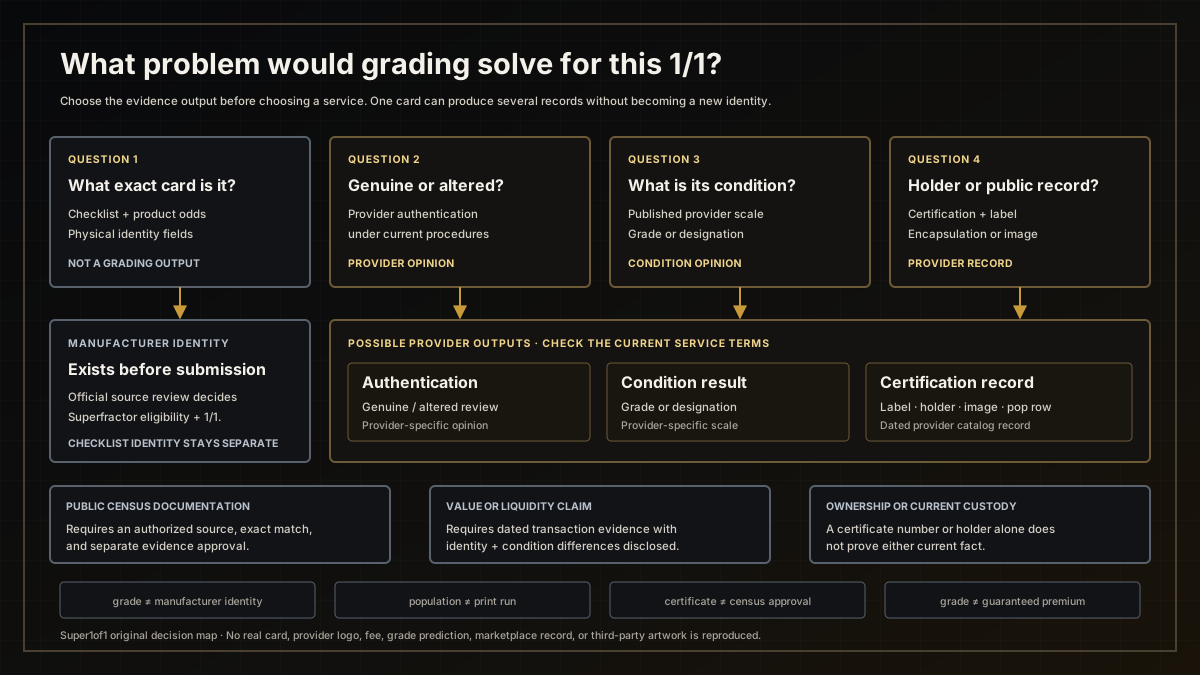
Six questions that grading cannot collapse into one
| Question | Best evidence | What it does not decide |
|---|---|---|
| What card is this? | Official manufacturer checklist, odds, and exact physical identity fields | A grading label cannot repair incomplete or contradictory product documentation. |
| Is the submitted card genuine or altered? | The grading service's authentication review under its current procedures and terms | That every online item using the same certificate number is the certified object. |
| What is its condition? | The service's grade under its published scale and standards | Manufacturer print run, census eligibility, or future value. |
| What was certified? | The service's certificate record, label details, and available holder images | A complete manufacturer checklist or universal catalog shared by every grader. |
| Has the copy been publicly seen? | An accepted public sighting matched to the exact canonical identity | A holder alone does not create the checklist identity, authenticate every online use, or establish current custody. |
| What is it worth? | Verified, dated transaction evidence with condition and identity differences disclosed | A grade does not supply an automatic premium for a unique card. |
What a grading service actually does
PSA's current trading-card process describes authentication, a condition grade on its scale when the card passes, and encapsulation with a grade and certification number. CGC's current card-grading process separately describes receiving, description verification, authentication, grading, encapsulation, imaging, quality control, and return shipping.
Those are provider-specific services and professional opinions. They can be useful evidence about the submitted object, but neither process replaces the official Topps checklist and product documentation that establish whether an exact identity is an eligible Superfractor 1/1.
How the 1/1 print run changes the decision
A Superfractor has no second copy of the same exact identity against which to rank its grade. That does not make condition meaningless: corners, edges, surface, centering, print defects, alterations, and handling history can still matter to a collector. It means the grade and the one-copy print run communicate different facts.
| Claim | Safe conclusion |
|---|---|
| “It is already 1/1, so condition never matters.” | Uniqueness prevents substitution with another copy of the exact identity; buyers and owners may still care about condition. |
| “A low grade destroys a 1/1.” | The card remains the same one-copy identity; any price effect requires actual transaction evidence. |
| “A high grade always raises value.” | A grade supplies a condition opinion. It does not guarantee demand, liquidity, or a sale premium. |
| “The slab proves it belongs in the Superfractor census.” | Census eligibility still depends on complete official product sources and exact identity matching. |
Read the standards and possible outcomes first
Published standards help identify what a service evaluates; they do not let an owner promise a grade. PSA's current grading standards describe grade-specific condition criteria and list cards it will not grade because of issues such as certain alterations or questionable authenticity. Its submission FAQ also explains that some “No Grade” outcomes can still incur the grading price because authentication and review occurred.
Eligibility, service levels, prices, declared-value rules, turnaround estimates, holder fit, guarantees, and shipping terms can change. Review the live service pages immediately before submission; do not use an old fee screenshot, forum answer, or this guide as the current contract.
Nine-step Superfractor grading decision worksheet
- Resolve the exact identity. Confirm year, manufacturer, product, set or subset, card number, subject, attributes, official Superfractor eligibility, and the 1/1 marking.
- Name the desired outcome. Write down whether the goal is a third-party authenticity opinion, condition grade, certification record, standardized holder, presentation preference, insurance documentation, or a venue requirement.
- Check current eligibility. Confirm the service accepts the exact issue, size, thickness, autograph, relic, alteration state, and submission type. A missing database entry is a question to resolve, not permission to choose the nearest label.
- Review the service, not its reputation shorthand. Compare current standards, terms, guarantee scope, imaging, holder, return process, and support for the exact card. Super1of1 does not rank or endorse grading companies.
- Pre-screen condition without predicting a result. Record visible corner, edge, surface, centering, print, autograph, relic, and size concerns under neutral lighting. Preserve uncertainty.
- Accept the outcome range. Decide in advance whether a lower-than-expected grade, an Authentic designation, a No Grade result, or a returned unencapsulated card would still satisfy the goal.
- Calculate the current all-in commitment. Include the applicable service, add-ons, membership requirement, declared-value tier, outbound and return shipping, insurance, tax, and expected time. Recalculate from current provider terms rather than storing a permanent price here.
- Plan custody. Record front and back images, the 1/1 marking, package inventory, carrier and insurance choices, tracking, and the provider's current packing instructions. Submission transfers a unique object through handling and transit.
- Test the value assumption and record the decision. Use verified sold evidence to compare graded and raw cards with disclosed differences. If the claimed benefit has no evidence, label it unknown, then record the decision and review date.
POP 1 vs. 1/1: what is the difference?
A manufacturer-issued 1/1 is a stated one-copy print run for one exact card identity. A POP 1 statement is only as precise as the provider, catalog identity, grade or designation row, displayed total, and review time it names. If a listing says only “POP 1,” open the current provider report and record which count actually equals one instead of upgrading the shorthand into a universal rarity, authenticity, or value claim.
| Observed phrase or result | Narrow meaning | What it cannot establish |
|---|---|---|
| 1/1 supported by matching manufacturer sources | The manufacturer states one copy of that exact checklist and parallel identity. | Condition grade, provider population, authenticity of the object being shown, ownership, or value. |
| POP 1 in one grade or designation row | The named provider displayed one item in that exact catalog row and grade or designation at the recorded time. | A one-copy manufacturer print run, one graded item across every row, or one distinct object across all providers. |
| Total population of one | The named provider displayed one item across the total the reviewed report actually defines at that time. | That no future submission, correction, reclassification, or separately cataloged record can change the result. |
| POP 1, none higher | The reviewed provider result showed one item in the named grade and no item in a higher grade row at that time. | A price premium, best-known condition across every provider, or a permanent ranking. |
| One matching record at two providers | Two provider-specific research records may relate to the claimed identity. | Two manufactured copies or two distinct physical objects without evidence linking or separating the submissions. |
| Population above one for an exact Superfractor 1/1 claim | The provider result conflicts with the expected one-copy identity and requires catalog, certificate, and physical-evidence review. | That the manufacturer printed multiple copies or that any specific holder or card is genuine. |
A certificate lookup confirms the grading company's database record for that number. PSA's certificate-verification page explicitly warns that number verification does not eliminate risk and that public certificate numbers can be reused on counterfeit labels. Match the physical holder, label, card, and any provider image instead of treating a number alone as proof of an online item.
A population report counts items recorded by one grading service under that service's catalog and display rules; it does not count copies manufactured. PSA's Population Report search notes recommend a detailed query that includes the card number and warn that some variety figures may be incomplete when recognition began after earlier submissions. CGC's population-report FAQ directs a collector who cannot find a certified card in the report to verify its certification number and follow that card's report link. A missing search result is therefore a dated provider-query result, not proof that a Superfractor is ungraded, unpulled, or nonexistent.
| Observed provider result | Narrow statement it supports | What it does not prove |
|---|---|---|
| No matching result | The exact recorded query returned no matching catalog row at the review time. | Zero graded copies, no certificate record, no private submission, or no physical card. |
| One matching grade or designation | The provider displayed one record in that catalog row and grade or designation at the review time. | Official checklist identity, present custody, current condition, or approved census evidence. |
| A displayed total above one for a claimed exact 1/1 | The provider displayed multiple records under the reviewed catalog identity; the conflict needs source and identity review. | That the manufacturer produced multiple copies or that any specific online object is genuine. |
| The claimed identity appears at two providers | Two provider-specific records may be relevant research leads. | Two distinct physical cards; continuity between the submitted objects is unresolved without stronger evidence. |
| A certificate page matches the visible card and holder | The current object can be compared with a provider record and any provider image. | Ownership, authority to sell, an unchanged condition, or a permanent public sighting. |
Never add population totals across grading companies and call the sum a unique-card population. Provider catalogs, labels, grades, designations, recognition dates, and searchable records are separate. For a true Superfractor, the expected one-copy identity comes from complete official product documentation; population records can document provider activity around that identity but cannot redefine its print run.
Six-step population snapshot
- Resolve the manufacturer identity first. Record the exact year, product, set or subset, card number, subject, autograph or relic attributes, official Superfractor eligibility, and 1/1 marking before searching a grader.
- Search one provider at a time. Use the most specific supported query and record the provider, public URL, exact search terms, and review time.
- Copy the provider label exactly into a private note. Preserve the displayed catalog identity, grade or designation rows, and counts without silently translating them into another provider's categories.
- Check the certificate path when available. Compare the record, provider image, physical holder, label, and card; keep missing or conflicting fields unresolved.
- Do not deduplicate by assumption. Records across grades or providers do not establish how many distinct physical objects they represent.
- State only the observed result. Use wording such as “this provider query displayed one matching record on this date,” then use the public-evidence tracker guide before making any pulled, missing, ownership, or census claim.
Reusable POP 1 and grading-population snapshot
Keep the query and interpretation together so a later reviewer can reproduce the narrow result.
Canonical card / official identity fields:
Official Superfractor eligibility source:
Population provider / public report URL:
Exact search terms / filters:
Review date and time:
Provider catalog identity displayed:
Grade or designation rows and counts:
Certificate record / provider image checked:
Missing fields or identity conflicts:
Other provider records kept separate:
Narrow supported statement:
Manufactured-count / distinct-object / custody / value inferences excluded:
Next review action:
Download the blank POP 1 snapshot CSV
The header-only file downloads directly to your device; Super1of1 does not receive, upload, or store what you add. Do not include a grading-account login, membership or order number, private submission record, owner contact, address, tracking number, or other sensitive data.
Reusable grading decision note
Record links and review dates because provider rules and prices change.
Exact identity and Superfractor eligibility:
Decision date:
Desired grading or holder outcome:
Service / submission type reviewed:
Eligibility, standards, terms, and fee URLs / review date:
Autograph, relic, size, or holder requirements:
Visible condition or alteration concerns:
Possible grade / Authentic / No Grade outcomes accepted:
Current all-in cost estimate and currency:
Declared-value basis:
Custody, packing, tracking, and insurance plan:
Verified sale evidence for any claimed value effect:
Decision and unresolved questions:
How Super1of1 uses grading evidence
A public grading-company record can be submitted as an independent source and matched to a canonical card. It affects the evidence timeline only after review and approval. It never creates a checklist card, changes Superfractor eligibility, or becomes a permanent marketplace observation merely because a seller title repeats the label.
The PSA and CGC grading, standards, certificate, and population-report sources cited above were rechecked on 2026-07-16. Super1of1 does not authenticate cards, predict grades, recommend a grading company, arrange submissions, or provide grading, insurance, tax, investment, shipping, buying, or selling advice. Use the identity worksheet first, then the valuation worksheet if price evidence matters and the sale-planning worksheet if a transaction is being considered. The canonical census remains limited to true Topps and Bowman baseball Superfractors from 2024 onward.