How Much Is a Superfractor Worth? 1/1 Comps Worksheet
Value a Superfractor 1/1 with no exact comp using verified sold evidence, identity and condition differences, explicit uncertainty, and a free CSV worksheet.
A Superfractor has no universal price. Its 1/1 print run establishes scarcity for one exact card identity, but value still depends on demand for that subject and identity, physical condition, transaction context, and the quality and recency of comparable sales. A useful estimate therefore shows its evidence and uncertainty instead of applying a generic “Superfractor multiplier.”
Quick answer
Verify the exact card first, then look for completed public transactions that match as many identity and condition fields as possible. If the unique card has never sold publicly, triangulate from several imperfect comparables and disclose every material difference. An active listing is an asking price—not proof of what the card sold for or is worth.
How do you value a 1/1 card with no exact comp?
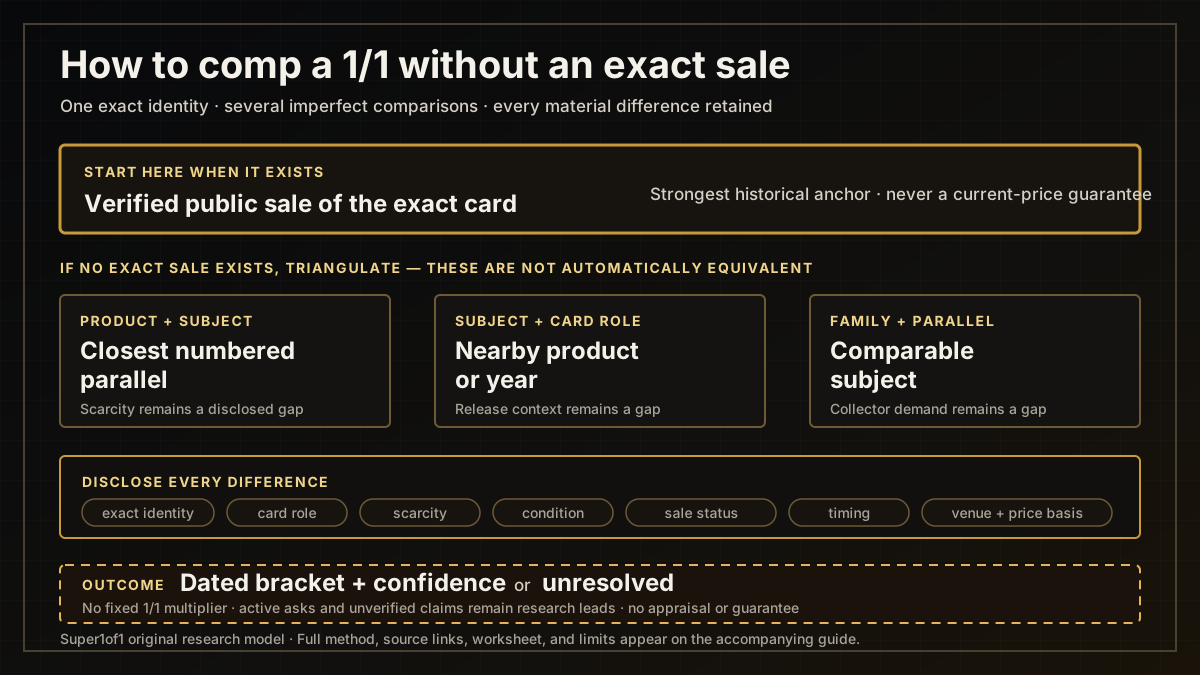
No exact repeat sale does not mean there is no comparison evidence. Build a small set of verified transactions that each answer one part of the question: the same subject in the closest numbered parallel can inform product and subject demand, while the same Superfractor family for a genuinely comparable subject can inform product and card-role context. Keep every mismatch visible, preserve the original sale facts, and leave the numeric result unresolved when the candidates do not support a defensible bracket.
Start with the exact identity, not the player name
Topps defines a Superfractor as the single 1-of-1 copy of a given card. That makes the full identity the unit being valued: year, manufacturer, product, set or subset, card number, subject, and attributes such as autograph, rookie designation, insert, relic, or image variation. Two Superfractors of the same player can be economically different cards.
Use the six-step identification worksheet before searching for prices. If the official checklist identity or Superfractor eligibility is unresolved, label the valuation unresolved too; a seller title cannot supply the missing identity.
A Superfractor comparable-evidence ladder
Because the target has one copy, an exact repeat-sale history is unusual. Expand the search deliberately and retain the differences instead of quietly treating the nearest result as identical.
| Evidence class | What it can contribute | Main limitation |
|---|---|---|
| Verified public sale of the exact card | The strongest historical transaction anchor for the identity | Condition, holder, sale venue, fees, date, or market demand may have changed. |
| Same subject and card role, nearby product or year | Subject demand and a similar identity role, such as base, autograph, or rookie | Product prestige, design, release timing, and checklist context differ. |
| Same subject and exact product, closest numbered parallel | Product, image, subject, and often condition-sensitive demand | A card numbered to five, ten, or more is not interchangeable with a unique Superfractor. |
| Same Superfractor family, comparable subject | Product, card family, parallel, and scarcity context | Collector demand for the subject can be materially different. |
| Price guide or aggregated auction record | A research lead and a way to locate candidate transactions | Coverage, matching rules, update timing, fees, and corrections may be unclear. |
| Active listing or unverified sale claim | Current seller expectations or a lead to investigate | It is not a completed transaction and cannot establish market value. |
Record the fields that make two sales comparable
| Dimension | Record for the target and every candidate | Why it matters |
|---|---|---|
| Canonical identity | Year, manufacturer, product, set or subset, card number, subject, and parallel | A false identity match invalidates every later comparison. |
| Card role | Base, insert, autograph, rookie, 1st Bowman, relic, variation, or combination | Different roles can attract different collector demand even for one subject. |
| Scarcity | Named parallel and stated print run | A /5 or /10 card supplies context, not a mechanical conversion to 1/1 value. |
| Condition | Raw or graded, grader and grade when applicable, plus disclosed flaws | PSA's card-value guidance identifies condition as a core component of trading-card value. |
| Transaction | Source URL, sold or unsold status, date, currency, format, disclosed price basis, and bid count when available | Auction, fixed-price, offer, private sale, and unsold listing records do not communicate the same facts. |
| Timing | Sale date and valuation date | A historical result is evidence about that transaction, not a timeless current price. |
Sold price, completed listing, and asking price are different facts
eBay's official pricing guidance tells sellers to examine similar items and completed listings, and its advanced-search guidance explains how to narrow by condition, format, and other filters. Those tools find candidates; the researcher must still verify what each result actually states.
Where can you find sold sports-card data?
eBay currently says its sports-card price guidance is available through Scan cards in the eBay app or My Collection on desktop and uses the preceding two years of market data. Depending on the matched card and available records, it can show median sold price, sold-price range, sale format, sale date, sold price, listing counts, and accepted Best Offer prices. These are useful discovery fields, not proof that the platform matched the exact Superfractor identity correctly.
Open the underlying result when it is available, verify the full card identity and transaction status, and record only the minimum facts needed for a private comparison note. Super1of1 does not ingest, cache, or republish account-specific sold-result data and does not imply Marketplace Insights access.
| Observed record | Safe interpretation | Do not claim |
|---|---|---|
| Completed, sold result with disclosed price and date | A public historical transaction record, subject to its stated terms and any unknowns | That the same card would sell for that amount today. |
| Completed but unsold listing | An offer that did not produce a disclosed sale under those terms | That its ask was accepted or represents market value. |
| Active fixed-price listing | A seller's current asking price | That a buyer agreed, paid, or will pay that amount. |
| Private-sale report without verifiable terms | A lead that may justify further source review | A precise comparable transaction. |
| Marketplace API observation | An accepted public sighting while provider-controlled listing details are fresh | A completed sale, canonical checklist identity, authenticity, ownership, or market value. |
Seven-step valuation worksheet
- Resolve the target identity. Complete the release, checklist, eligibility, serial-number, and physical-consistency checks before collecting prices.
- Search exact-to-broad. Start with the complete identity and card number, then relax one field at a time so every candidate's distance from the target remains visible.
- Verify the original result. Record the source, transaction status, date, currency, format, disclosed price basis, grade or condition, and bid count when available. PSA similarly recommends refining auction searches with year, manufacturer, subject, and card number.
- Build a difference ledger. Mark every match and mismatch across identity, role, scarcity, condition, subject, timing, and venue. Never erase a difference to make a comp look cleaner.
- Triangulate. Prefer several candidates that illuminate different dimensions over one distant sale that merely has “Superfractor” in its title.
- State a bracket and confidence. Explain which transactions anchor the lower and upper context, what qualitative adjustments remain, and whether evidence confidence is strong, moderate, weak, or unresolved.
- Date the conclusion. Preserve the valuation date and source-access dates. Recheck the sources before any sale, purchase, insurance, tax, or grading decision.
Why a universal Superfractor multiplier fails
Multiplying the price of a /5 card by five, a /10 card by ten, or a base card by a fixed “1/1 premium” assumes demand changes in a straight line with scarcity. The reviewed sources do not support that assumption. Different subjects, card roles, products, conditions, and sale formats can move independently, and a unique card may have only one interested buyer at a given time.
A numbered parallel can still be useful when it holds most identity fields constant. Treat it as one comparison with a disclosed scarcity difference, not as an equation that produces the answer.
How to describe confidence
| Label | Minimum evidence | Required disclosure |
|---|---|---|
| Strong | A recent, verifiable exact-card transaction with comparable condition and clear price terms | Changes in time, venue, condition, fees, or demand since the sale |
| Moderate | Several verifiable sales that collectively match subject, role, product, scarcity, and condition | Every remaining mismatch and why the chosen bracket is still informative |
| Weak | Only older, distant, aggregated, or single-dimension comparables | That the result is broad context rather than a reliable current estimate |
| Unresolved | No verified sold evidence or unresolved target identity | No numeric conclusion; list the missing evidence needed to continue |
Reusable Superfractor valuation note
Keep one record per candidate comparable so later corrections do not rewrite the original research.
Target identity and Superfractor eligibility:
Valuation date:
Target condition / holder / grade:
Candidate source URL and access date:
Sold, unsold, active, or unverified status:
Transaction date / format / currency:
Disclosed price and fee basis:
Identity fields that match:
Identity fields that differ:
Condition and timing differences:
Reason included or excluded:
Valuation bracket / confidence:
Unknowns that could change the conclusion:
Download the blank 1/1 comps CSV
The blank file contains only comparison headings. It downloads directly to your device; Super1of1 does not receive, upload, or store what you add. Keep owner, contact, account, and private transaction details out of the worksheet.
What this worksheet does not do
Super1of1 does not appraise cards, predict investment returns, authenticate physical cards, or provide tax, insurance, grading, buying, or selling advice. A valuation note is a dated research estimate, not a guarantee. PSA's own price-guide notes caution that published prices may not reflect the premium associated with a low-population card; a unique Superfractor requires even more explicit handling of sparse evidence.
Accepted fresh marketplace observations on Super1of1 count as public sightings but remain separate from the canonical checklist. Exact matches contribute to seen coverage; unmatched accepted items remain provisional observed cards. When a source expires, controlled listing fields are scrubbed and generic normalized sighting facts remain. Use the Superfractor grading decision worksheet before treating a holder or grade as part of a valuation, then use the Superfractor sale-planning worksheet before choosing a venue or listing format. The canonical census remains limited to true Topps and Bowman baseball Superfractors from 2024 onward.