What Is a Superfractor? A 1/1 Trading Card Explained
Learn what makes a Superfractor a 1/1, whether every Topps Chrome card has one, and how to resolve real gold, missing serial, /50, or label conflicts.
A Superfractor is a one-of-one parallel made for one exact card identity. Topps describes it as the rarest type of Refractor and a short-printed 1-of-1 card in its official Superfractor definition. A 1/1 serial stamp is essential, but it does not identify the parallel or the checklist entry by itself.
Quick answer
A card is a true Superfractor only when three facts agree: the product documentation makes that card family eligible for a Superfractor, the card matches one exact checklist identity, and the physical copy is the 1/1 Superfractor for that identity. Appearance, scarcity, a grading label, or a marketplace title can support research, but none replaces those three checks.
Build a private Superfractor identity research note after working through the checks below.
How rare is a Superfractor?
For one exact eligible Superfractor identity, the stated print run is one copy. That does not mean one Superfractor per player, one per product, or one universal chance per pack. Name the denominator before describing rarity.
| Rarity question | Precise answer | Evidence required |
|---|---|---|
| How many copies of this exact Superfractor? | One stated copy for the complete eligible card identity. | Official Superfractor definition, exact checklist identity, and family eligibility. |
| How many Superfractors are in the release? | One for each exact checklist identity made eligible for the parallel. | Complete checklist reconciled with the applicable official product documentation. |
| What are the pack or box pull odds? | Product-, family-, configuration-, and unit-specific; no universal denominator applies. | The exact official odds row and matching configuration column. |
| How many have been publicly seen? | Accepted public sightings count; this is an observation total, not a print run or sealed-pack estimate. | An exact match from a fresh official-API listing or reviewed independent evidence tied to the canonical identity. |
Does every Topps Chrome card have a Superfractor?
No. Topps Chrome branding does not answer whether every base card, insert, autograph, relic, or variation in a release receives a Superfractor. Each exact card family can have its own parallel ladder. Topps's statement that there is one Superfractor “for any given card” defines the copy count after the eligible card identity is known; it does not make every checklist entry Superfractor-eligible.
Two official 2025 baseball product guides show the distinction without relying on a marketplace title or a general hobby rule. The 2025 Topps Chrome Baseball guide names SuperFractor 1/1 within the base, named insert, image-variation, and autograph ladders it describes. The 2025 Bowman Baseball guide separates paper and Chrome families even inside one release.
| Official 2025 example | One-copy wording in the cited family list | Safe classification |
|---|---|---|
| Topps Chrome Baseball base set | SuperFractor 1/1 and Printing Plates 1/1 | The cited base-family ladder supports Superfractor eligibility; the exact base checklist identity still has to match. |
| Topps Chrome Homefield Advantage Image Variations | SuperFractor 1/1 | This exact variation family can have a Superfractor; that does not make every image variation in every product eligible. |
| Bowman Paper Prospect & Base Parallels | Platinum and Printing Plates are the named 1/1s | A paper one-of-one in this list is not renamed Superfractor from a neighboring Chrome family. |
| Bowman Chrome Prospect Refractor Parallels | Superfractor and Printing Plates are the named 1/1s | The cited Chrome prospect family supports a Superfractor identity after exact checklist reconciliation. |
| Bowman Paper Rookie/Vet Autos | Platinum 1/1 | The cited paper autograph ladder does not inherit Superfractor from the separate Chrome autograph ladder. |
These are classification examples, not a republished checklist or a complete 2025 census. Reconcile the exact family in the official Topps checklist library with its entry in the official odds library or comparable manufacturer documentation. An omission from a summary page does not prove exclusion; when complete official sources do not resolve eligibility, the result stays unresolved or the release stays blocked. No neighboring family can donate its Superfractor eligibility.
Census rule
Super1of1 counts an expected card only when official sources support the exact family as a Superfractor with a 1/1 print run and the complete checklist identity can be established. Chrome branding, a player's presence elsewhere in the release, or another family's one-of-one does not create a canonical Superfractor card or change the expected-card total. Accepted marketplace and collector sightings are counted separately.
Use the configuration-specific pack-odds and set-count guide for the calculation, and the multiple-Superfractor identity guide when one player appears in more than one eligible family.
How to identify a Superfractor
Use this verification worksheet in order. If an official source is incomplete or two fields conflict, stop at unresolved instead of filling the gap from a seller claim.
| Check | What to verify | Why it matters |
|---|---|---|
| 1. Release | Year, manufacturer, brand, product, edition, and applicable configuration | Similar names can refer to different releases or parallel structures. |
| 2. Checklist identity | Set or subset, card number, subject, and attributes such as autograph, insert, rookie, or image variation | The one-of-one print run belongs to this exact identity, not to the player generally. |
| 3. Parallel eligibility | Official product odds or other official product documentation naming a Superfractor for that card family | A checklist entry does not automatically receive every parallel in the product. |
| 4. Serial number | An explicit 1/1 marking that belongs to the card rather than a holder, autograph notation, or seller overlay | Other Refractors and gold parallels can look similar but have larger print runs. |
| 5. Physical consistency | Front and back details that agree with the release, identity, and named parallel | Visual design is corroboration; it cannot cure a checklist or serial-number conflict. |
| 6. Source agreement | No unresolved mismatch among checklist, odds, card number, subject, subset, or meaningful variation fields | A trustworthy identity records uncertainty instead of manufacturing an answer. |
Checklist and odds answer different questions
The official Topps checklist library establishes the factual members of a release: card numbers, subjects, and named sets or subsets. Product odds or comparable official product documentation establish which card families can receive the Superfractor parallel. Both are needed because a release can contain many inserts and variations without giving every family the same parallels.
When odds name an eligible family but the official checklist does not enumerate its exact cards, Super1of1 leaves the release blocked rather than publishing a partial census. “Not enough official documentation” is a valid result.
The same source discipline applies to historical claims. The source-checked Superfractor timeline documents a manufacturer-published 2005 example while preserving conflicting archive claims instead of turning a current definition into an unsupported first-release date.
What does a Superfractor look like?
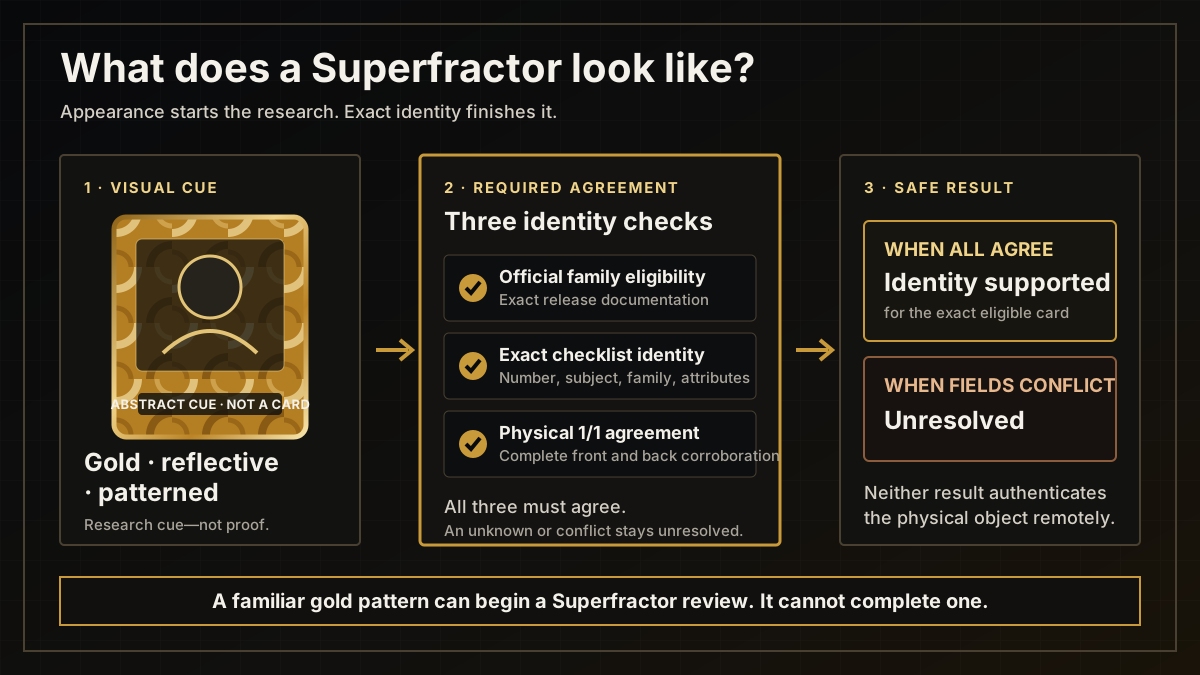
A candidate Superfractor may look gold-toned, reflective, and patterned, but those are visual research cues rather than a universal identity test. Topps explains that Refractor cards use a prism or rainbow-like visual effect and that products can contain multiple named Refractor colors with different quantities. Another gold or patterned card can therefore resemble a Superfractor without sharing its official name or one-copy print run.
Inspect complete current front-and-back views under ordinary changing light, then record the card number, printed parallel wording, serial area, autograph or relic state, and meaningful variation details. If the repeating pattern uses MLB logos or the product says Logofractor Edition, compare the exact Logofractor and Superfractor identities instead of treating the finish as the parallel name. Do not match from hue, pattern, a cropped photo, or a generic example alone; release-specific official sources still control the identity.
Are Superfractors made of real gold?
The reviewed Topps sources do not establish that Superfractors contain precious-metal gold. The official Superfractor definition establishes a short-printed 1-of-1 identity but publishes no universal material specification. Treat a gold color, reflective pattern, or product name as a design or classification clue—not proof of elemental composition—unless an official specification for the exact release states otherwise.
Material wording is source-specific. A Topps collector story about one 2024 Topps Chrome Formula 1 Helmet Collection Superfractor describes that card's background as a “gold vinyl substrate.” That product is outside Super1of1's baseball census and is used here only to show why material claims must stay release-specific. The wording supports the named card's background description; it does not establish the chemistry, precious-metal content, or construction of every Superfractor. An official 2024 Topps Finest Baseball product breakdown separately lists Gold Refractor /50 and SuperFractor 1-of-1, so gold naming and Superfractor identity are not interchangeable.
| Observed wording or appearance | Safe conclusion | What remains unproved |
|---|---|---|
| Gold-toned or reflective pattern | A visual cue worth matching to the exact product documentation. | Precious-metal content, the named parallel, print run, or authenticity. |
| “Gold vinyl substrate” in the cited Topps story | A manufacturer-published description of one named card's background. | A universal Superfractor material recipe or elemental composition. |
| Gold Refractor in a parallel list | A named parallel whose print run must be read from that release's sources. | That the card is a Superfractor or contains gold. |
| No exact-release material specification | Record the physical composition as undocumented. | Permission to infer a material from another card, year, product, image, or seller claim. |
Do not scratch, scrape, peel, dissolve, heat, bend, cut, or open a holder to test composition. A destructive material test can damage the sole physical copy and cannot establish checklist identity or Superfractor eligibility. If construction matters for conservation, insurance, or a condition decision, seek exact-release documentation from the manufacturer or a qualified conservator and keep that opinion separate from the census evidence record.
| Common signal | What it proves | What it does not prove |
|---|---|---|
| Gold or patterned finish | The card may be a Refractor parallel worth investigating. | That the named parallel is Superfractor or that the print run is one. |
| 1/1 stamp | The marked identity claims a one-copy print run. | That the card is a Superfractor rather than another 1/1, printing plate, or unique insert. |
| Fresh official-API listing | An accepted public sighting at the recorded time. | Canonical checklist identity, parallel eligibility, authenticity, ownership, or a completed sale. |
| Grading label | A third party assigned the description shown on its holder. | Complete official checklist coverage or resolution of conflicting product sources. |
Card says “Superfractor” but has no 1/1 or is numbered /50: what does that mean?
It means the printed fields conflict—not that one field automatically wins. Topps's official definition makes the one-of-one print run part of a Superfractor. An explicit /50 therefore does not become a second type of Superfractor merely because that word is printed elsewhere on the card. The official 2024 Topps Finest Baseball product breakdown, for example, lists Gold Refractor /50 and SuperFractor 1-of-1 as separate parallel names in multiple families.
Do not automatically rename a conflicting card Gold Refractor either. The complete serial notation records only the observed position and claimed print run; the exact official product and family sources must establish the parallel name. A printed Superfractor label without matching 1/1 numbering, official family eligibility, and physical identity remains unresolved. It could involve a production printing error, an incorrectly identified card, or incomplete evidence, but a remote photo, grading label, or marketplace description cannot decide which.
| Observed conflict | Record | Safe working result |
|---|---|---|
| “Superfractor” is printed, but no 1/1 appears | Complete front and back, exact label text and location, card number, subject, product, and the entire expected serial-number area | Printed-label conflict. The word is a clue; it does not establish a one-copy print run. |
| “Superfractor” is printed, but the card is numbered /50 | The complete numerator and denominator, their location, exact printed parallel wording, physical finish, checklist identity, and applicable official family source | Serial-number conflict. Record /50 as observed, but call the parallel unresolved until every exact field and official source agrees. |
| A 1/1 appears, but official sources do not make that family Superfractor-eligible | The marking and its location, exact checklist identity, every applicable odds or product source, and any source conflict | One-of-one claim; Superfractor unresolved. Other 1/1 card types exist. |
| The label, finish, card number, or autograph state disagree | Each field separately, without normalizing one to match another | Physical-identity conflict. Neither appearance nor a printed word cures the mismatch. |
| Several public posts or listings show similar text | Each permitted source and observation time as a separate claim | Repeated claim, not a copy count. It does not prove the cause, rarity, authenticity, or location of the intended Superfractor. |
Six-step Superfractor error-card triage
- Preserve the card as found. Do not clean, erase, scratch, peel, press, mark, or alter a label or serial area to test a theory.
- Create one complete original record. Capture the full front and back, label wording, serial area, card number, subject, and product trail. Keep receipts, wrappers, account details, and addresses private.
- Resolve the intended identity. Use the official checklist for the exact card entry and the applicable official odds or product documentation for Superfractor eligibility. Do not substitute a similar player card or seller title.
- Name only the observed conflict. Use a bounded label such as printed-label conflict, serial-number conflict, physical-identity conflict, or unresolved. Do not call the object a rare error card, estimate its population, or assign a premium from the mismatch alone.
- Check the current manufacturer route. Topps's product-defect support page, reviewed on 2026-07-15, includes printing errors among possible manufacturing defects and describes current-year review. Eligibility and any remedy remain subject to the live policy and Topps's decision, so preserve the product trail and read the current requirements before transferring custody.
- Keep the census separate. A conflicting physical card still counts as a public sighting, but it does not create another canonical checklist identity. Preserve concrete identity or duplicate-object conflicts for review until the exact card relationship can be resolved.
Reusable Superfractor label-error record
Record what the card shows before naming a cause. Keep private account, transaction, and support details out of public evidence.
Release / product / edition / configuration:
Set or subset / card number / subject:
Exact printed Superfractor wording and location:
Serial numbering shown / absent / obscured:
Complete front and back recorded:
Parallel finish / autograph / relic / variation fields:
Official checklist URL / reviewed date:
Official odds or product URL / reviewed date:
Expected exact identity and eligibility:
Fields that agree:
Printed-label / serial-number / physical-identity conflicts:
Manufacturer support policy / reviewed date:
Private support case and product trail retained:
Independent public evidence / permission state:
Working outcome and unresolved questions:
What a 1/1 serial stamp can establish
Read a 1/1 stamp as one narrow proposition: the marked card claims a one-copy print run for the identity the marking modifies. It does not say what that identity is. The release, checklist entry, named parallel, physical card, and public evidence are separate questions that must agree.
| Research question | Required evidence | Can the stamp answer it alone? |
|---|---|---|
| Is the named parallel a Superfractor? | Official product odds or comparable official documentation for that exact card family | No. Other manufacturer-issued cards can also be 1/1. |
| Which card identity owns the print run? | Exact checklist entry plus matching set, subset, number, subject, and identity-changing attributes | No. The same player can have several distinct one-of-one cards. |
| Is the physical card consistent with that identity? | Front and back details that agree with the official sources, without an unresolved alteration or mismatch | No. A stamp cannot resolve contradictory physical or source details. |
| Has the copy been publicly seen? | An accepted public sighting tied to the exact canonical identity | No. A serial number is not an evidence timeline. |
Super1of1 documents checklist identity and reviewed public evidence. It does not authenticate physical cards, certify alterations, or convert a holder label or seller description into manufacturer evidence.
How to tell whether a Superfractor claim is credible
This is non-destructive triage, not remote authentication. Start with the official identity, then compare the offered physical object and any holder record. Never bend, scratch, peel, clean, cut, or open a holder to perform a home test. Preserve the card's current condition, following the same reversible handling principle described in Topps's collection-protection guide, and use current original front-and-back images or an in-person professional review.
| Research layer | Safe check | What the result means |
|---|---|---|
| Official identity | Confirm the exact release, edition, set or subset, card number, subject, identity-changing attributes, Superfractor eligibility, and 1/1 print run in official product sources. | A matching identity makes the claim possible. Missing or conflicting documentation leaves it unresolved. |
| Physical consistency | Compare current original images of the complete front and back with the checklist identity, printed number, serial marking, autograph or relic status, and meaningful variation fields. | Agreement makes the object consistent with the identity; it does not authenticate the object. |
| Holder record | For a holdered card, use the grader's own lookup, such as PSA Cert Verification or CGC Certification Verification, and compare every displayed field and available holder image. | A matching database record supports the holder claim. PSA explicitly warns that a valid certification number does not eliminate counterfeit risk because public numbers can be copied. |
| Transaction inspection | When buying, verify whether the exact listing currently qualifies for a physical-inspection program. For example, eBay's trading-card Authenticity Guarantee applies only to eligible transactions and states separate limits for autographs, relics, categories, locations, and listing terms. | A completed inspection belongs to that transaction. It is not official product documentation, a universal guarantee, or a permanent census event. |
| Public sighting | Review an official API listing or independent source that shows the exact identity at a recorded time, then preserve only the permitted factual evidence and source history. | An accepted sighting documents public appearance. It does not establish current ownership, custody, or physical authenticity. |
When two 1/1 claims appear to conflict
Two listings, posts, or photographs do not prove that two physical copies exist. A source may reuse an image, omit an identity-changing field, show a different subset or variation, or describe a card incorrectly. Compare the claims field by field before treating them as duplicates.
- Record each claim separately with its source and observation time; do not copy a marketplace title into the canonical identity.
- Compare release, edition, set or subset, card number, subject, autograph or relic status, and every meaningful variation field.
- Compare complete front-and-back images and distinct physical markers. Cropped, watermarked, or repeated images cannot establish separate objects.
- For holdered cards, verify the certification on the grader's current site and compare the label data and available holder image, not just the number.
- If the same exact identity still appears on distinct physical objects, mark the physical-authenticity conflict disputed. Do not create a second canonical card, promote a marketplace claim as proof, or accuse a person from images alone; route the object to the manufacturer, grader, marketplace inspection process, or another qualified in-person reviewer.
Reusable authenticity-triage record
Keep this record private when it contains transaction or ownership information. Record uncertainty directly and do not include seller names in a public census note.
Claimed release / product / edition:
Checklist identity / card number / subject:
Identity-changing attributes:
Official checklist URL / reviewed date:
Official odds or product URL / reviewed date:
Current front-and-back source / observed date:
Serial marking and location:
Holder company / certification / lookup date:
Holder record and image agreement:
Possible duplicate claim / observed date:
Conflicts or unknowns:
Working outcome:
Use a bounded outcome such as identity plausible, checklist conflict, holder mismatch, duplicate claim unresolved, disputed, or physical authentication required. None is a remote authenticity certificate.
Why one player can have several Superfractors
The “one” in 1/1 applies to the complete checklist identity. A base card, autograph, insert, image variation, and other distinct entry for the same player can each have its own eligible Superfractor 1/1. They are not duplicates when their official identity fields differ. First separate the base card, parallel, insert, and variation structure, then compare the result with other one-of-one trading cards.
What to record during research
- Release year, manufacturer, brand, product, and edition.
- Set or subset, exact card number, and subject as printed in the official checklist.
- Autograph, relic, rookie, insert, variation, or other identity-changing attributes.
- Official checklist and product-odds URLs, review date, and a hash of the reviewed input.
- The explicit Superfractor label and 1/1 print run supported by the sources.
- Any ambiguity, contradiction, exclusion, or missing official documentation.
Reusable Superfractor research note
Copy this field list into your own notes. A blank field is an unresolved fact, not permission to infer an answer from a similar card.
Release year / manufacturer / product / edition:
Set or subset:
Card number and subject:
Identity-changing attributes:
Official checklist URL / reviewed date:
Official odds or product URL / reviewed date:
Exact Superfractor eligibility wording:
Serial text shown on the card:
Independent evidence source / observed date:
Conflicts or unknowns:
Working outcome:
Use a clear outcome such as checklist verified, not yet seen, public marketplace sighting, provisional observed card, moderator-confirmed match, disputed, or unresolved.
Store factual fields and source links, not copies of manufacturer checklists or images. This keeps the research reproducible while respecting the source material.
Census identity and public evidence are separate
A checklist-verified card can belong in the census before Super1of1 has seen it publicly. The public label is not yet seen. An accepted fresh official-API listing counts as a public sighting: an exact match contributes to the canonical card's seen coverage, while an accepted unmatched item becomes a provisional observed card. Neither path creates an official checklist identity or changes the expected-card denominator.
Use the result
If the card was just opened, use the first-hour Superfractor checklist before making a grading, value, or sale decision. If you are evaluating somebody else's card, complete the Superfractor buyer checklist before committing funds. Then read what “unpulled” and not yet seen mean, distinguish a 1st Bowman Superfractor from rookie, prospect, and autograph identities, or use the grading and valuation worksheets only after resolving the exact identity. The current census scope is true Topps and Bowman baseball Superfractors from 2024 onward.
Original research tool
Build a Superfractor identity research note
Record the exact card claim field by field, then copy or download a plain-text note for source review. This tool runs in the page: it does not submit, upload, or persist anything you type.