When Did Superfractors Start? A Source-Checked Timeline
Research when Superfractors started, the January 2005 Topps Chrome debut candidate, a verified Bowman Chrome example, and why the first remains unresolved.
The earliest dated product candidate found in this review is 2005 Topps Chrome Series 1, which Beckett's set catalog dates to January 2005. A later Beckett retrospective about Series 1 describes 2005 Topps Chrome as the Superfractor's debut, while PSA's set profile catalogs Gold SuperFractor parallels in the two-series product. Those secondary sources make January 2005 a supported research candidate, not card-level proof of the first release. Topps independently documents a Superfractor in 2005 Bowman Chrome Baseball.
Quick answer
Superfractors are documented in 2005, and January 2005 Topps Chrome is the earliest dated candidate found in this review. The January date comes from Beckett's set catalog, and the same publisher's later Series 1 retrospective describes the product as the debut. PSA independently catalogs Gold SuperFractor parallels for the two-series product, while Topps's own archive confirms a later 2005 Bowman Chrome Superfractor. These later records do not exclude every earlier release, so the first Superfractor remains unresolved.
Source-checked Superfractor timeline
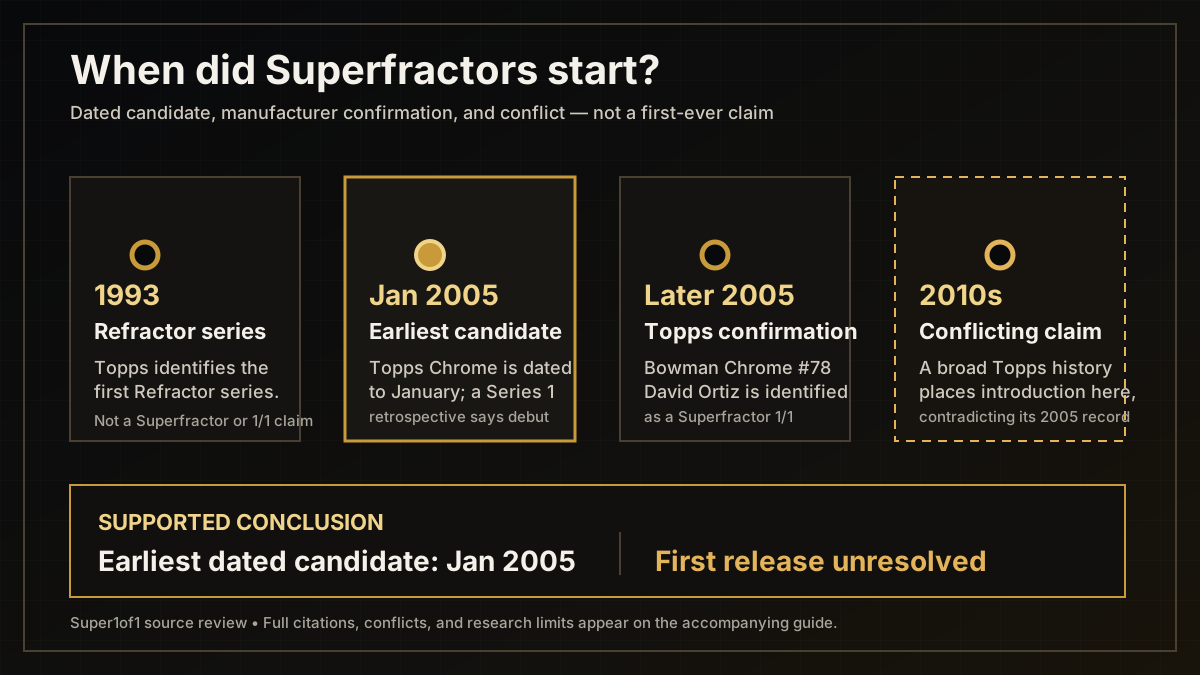
| Date | What the reviewed source supports | What it does not establish |
|---|---|---|
| 1993 | Topps calls Baseball's Finest the first Refractor series in its baseball-card technology history. | That the 1993 Refractor was a Superfractor or a one-of-one parallel. |
| January 2005 candidate | Beckett's 2005 Topps Chrome catalog dates Series 1 to January 2005; a later Beckett Series 1 retrospective describes the product as the debut; and PSA's two-series set profile catalogs Gold SuperFractor parallels for the product. | A contemporaneous manufacturer statement, a card-specific January record, or a complete exclusion of every earlier product. This is the earliest dated candidate found, not a proven first. |
| Later 2005 | A Topps article identifies 2005 Bowman Chrome Baseball #78 David Ortiz as a Superfractor 1/1. | That this card, family, or product was the first Superfractor ever released. |
| 2010s | The same Topps technology history broadly places the introduction of 1-of-1 Superfractors in the 2010s. | A chronology consistent with Topps's card-specific 2005 record; the two manufacturer-published claims conflict. |
| Current usage | Topps's official definition describes a Superfractor as a short-printed 1-of-1 Refractor, while a 2025 Bowman product overview lists Superfractors and Printing Plates as separate 1/1 categories. | The date or product in which the Superfractor name first appeared. |
Why January 2005 Topps Chrome is a candidate, not a verdict
The candidate combines three distinct facts: a cataloged January Series 1 release date, a later Series 1 editorial debut claim, and an independent catalog of Superfractor families in the two-series product. Together they are more precise than an undated hobby recollection. They still are not contemporaneous Topps product documentation or a card-specific January record, and later sources can repeat the same incomplete history. The January 2005 date is therefore the earliest dated candidate located in this review—not a claim that the search is exhaustive.
Documented in 2005 is not the same as first in 2005
A dated example answers one question: how early can the reviewed evidence place the parallel? It does not answer a broader question: was every earlier release checked, and did none contain one? Proving a first requires both a verified candidate and enough complete earlier product documentation to exclude earlier use.
The distinction matters because an archive is not necessarily complete. An unsuccessful search for an older official record is absence of evidence, not evidence that an older card never existed. Marketplace titles, auction descriptions, grading labels, forum posts, and repeated hobby lore cannot close that gap.
How to handle the conflicting Topps claims
The card-specific Topps record and the broad Topps retrospective cannot both describe the introduction date literally: a card identified as a 2005 Superfractor predates the 2010s. For the narrow lower-bound claim, the dated product, card number, subject, parallel name, and 1/1 designation are more specific evidence. Super1of1 therefore records “documented by 2005” and preserves the contradiction instead of silently selecting a first-ever year.
| Claim | Review outcome | Reason |
|---|---|---|
| Refractors began in 1993 | Supported by the reviewed Topps history | The manufacturer explicitly identifies the 1993 series as the first Refractor series. |
| January 2005 Topps Chrome is the earliest dated candidate found | Supported as a research finding | Beckett dates Series 1 to January and later describes the product as the debut in a Series 1 retrospective; PSA independently catalogs the product's Superfractor families. |
| Superfractors existed in 2005 | Supported by a card-specific Topps record | The record supplies a product year, product, card number, subject, parallel name, and 1/1 designation. |
| 2005 Topps Chrome was the first Superfractor release | Unresolved | The reviewed sources are retrospective and do not exclude every earlier product. |
| Superfractors were introduced in the 2010s | Contradicted within the reviewed Topps archive | The same publisher identifies a 2005 Superfractor. |
| The 1993 Refractor was a Superfractor | Unsupported | The source names a Refractor series, not a Superfractor 1/1. |
What evidence would establish the first Superfractor?
A defensible first-release claim needs contemporaneous manufacturer evidence: an official checklist, odds sheet, sell sheet, product announcement, or equivalent archive record that explicitly connects the Superfractor name and 1/1 print run to an exact dated release. The review must also account for earlier candidate products and define whether “first” means the first product, card family, physical card produced, or public release date.
- Name the candidate precisely. Record manufacturer, year, brand, product, edition, card family, and applicable configuration.
- Require explicit terminology. The source must name the Superfractor parallel and its one-copy print run rather than relying on a visual resemblance.
- Prefer contemporaneous product documents. Later retrospectives are useful leads but can compress or misstate a timeline.
- Review earlier releases. A first-ever claim remains unresolved if official documentation for plausible predecessors is unavailable or incomplete.
- Publish contradictions. Conflicting primary-source claims belong in the result, not in discarded research notes.
What Superfractor means today
The current Topps definition is identity-specific: for any given card, there is one Superfractor in the product. It does not mean there is only one Superfractor per player or product. Use the identification worksheet to verify one card, or the quantity and odds guide to count eligible identities without confusing a per-card print run with a product total.
Source review and scope
This review used manufacturer-published Topps pages plus PSA's card catalog and Beckett's set catalog and editorial archive, rechecked on 2026-07-16. Super1of1 stores links and factual findings rather than copies of source documents or images. The review identifies the earliest dated candidate found in this source set, not a complete history of every manufacturer or sport. A newly located contemporaneous or earlier source should trigger a dated correction and revision.
This history guide does not expand the Super1of1 census. The canonical census remains limited to true Topps and Bowman baseball Superfractors from 2024 onward, with complete-set publication and approved-evidence rules defined in the census methodology.