Superfractor Checklist, Pack & Case Odds Calculator
Reconcile official Topps checklists and odds, count eligible Superfractor 1/1 identities, and calculate pack or case chances without inventing print runs.
Use the blank checklist-and-odds worksheet to reconcile official product sources, then use the Superfractor pack and case odds calculator below to model one published family-level odds line. Counting eligible identities and modeling pull probability are different questions: a product can contain hundreds of Superfractors even though every Superfractor is a one-of-one. Topps defines a Superfractor as a short-printed 1-of-1 Refractor. The one-copy print run belongs to each exact eligible checklist identity, not to the entire product, player, or card family.
Can you pull a Superfractor from a retail blaster?
Sometimes—but not from every release, card family, or retail format. Manufacturer documentation must connect the exact product, family, and configuration; when configuration-level odds exist, use the matching Superfractor cell. A retail pull from one product does not establish retail eligibility for another family, year, or release.
Are Superfractors case hits?
Not as a universal guarantee. A published one-in-many-packs Superfractor line describes an average family frequency for the named configuration. It does not promise one Superfractor in every sealed case. Treat “case hit” as a guarantee only when current official documentation explicitly guarantees the exact named family at that unit; otherwise calculate a probability from the matching pack odds and exact case contents.
Quick answer
The expected number of Superfractors in a product equals the number of exact checklist identities that official product documentation makes eligible for the parallel. If 275 exact identities are eligible, the expected total is 275 Superfractors: one copy of each identity. The answer remains unresolved when the official checklist or eligibility documentation is incomplete.
Four numbers that answer different questions
“How many are there?” is ambiguous until the unit is named. Checklist count, print run, pull odds, and estimated production are related, but they are not interchangeable.
| Number | What it measures | Example meaning |
|---|---|---|
| Eligible identity count | Exact base, insert, autograph, variation, or other checklist identities that can receive the parallel | 275 different Superfractor cards are expected. |
| Print run | Copies of one exact parallel identity | Each eligible Superfractor identity has one copy. |
| Pull odds | Average frequency of a named hit in a specified pack, box, or other product unit | One hit from a family is expected per stated number of units. |
| Estimated production | Units produced or packed under explicit allocation assumptions | An estimate derived from eligible copies and odds, not a checklist fact. |
How to read a Topps checklist and odds sheet together
The checklist identifies card families and exact card identities; the odds sheet or another official product source identifies which named parallel applies to which family and configuration. Neither source can fill a material gap in the other. Open the current official version of both, record the review date, and preserve every family-name mismatch, omitted configuration, and unresolved variation instead of forcing a total.
- Fix the release and configuration. Record the year, brand, product, edition, geography, and pack or box format. Similar product names can have different checklists or parallel allocations.
- Enumerate exact checklist identities. Use the official Topps checklist library to identify card number, subject, set or subset, and identity-changing attributes.
- Identify eligible card families. Review the applicable official odds or product documentation for an explicit Superfractor line. A checklist entry does not automatically receive every parallel in the release.
- Reconcile the sources. Match every eligible family to its exact checklist identities. Do not infer an undocumented variation, exclusive, or autograph family from a different product.
- Sum the eligible identities once. Remove exact duplicates while preserving genuinely different base, insert, autograph, relic, and variation identities.
Blank Superfractor checklist and odds worksheet
Use one row per exact checklist identity. Record the checklist family and the corresponding odds or product-source family separately, then classify the row as eligible, excluded, or unresolved. A stable identity key helps expose duplicate rows without merging genuinely different base, autograph, insert, relic, or variation cards.
Download the blank checklist and odds CSV
The header-only file contains no Topps checklist data, player data, odds, images, marketplace information, or private collection details. It downloads directly to your device; Super1of1 does not receive, upload, or store what you add.
The checklist and odds formulas
| Question | Calculation | Required evidence |
|---|---|---|
| How many Superfractor identities are expected? | Sum of exact identities in every eligible card family | Complete checklist plus applicable official parallel eligibility documentation |
| How many Superfractor copies are expected across those identities? | Eligible identity count × 1 copy | The official 1/1 Superfractor definition and complete eligibility mapping |
| How many product units might contain a format-specific family? | Eligible identity count × published odds denominator | Odds stated per that unit, all copies allocated to that pool, and no conflicting configuration |
The first two calculations describe the checklist. The third is a conditional production estimate. It is not valid merely because an odds sheet contains a large denominator.
A generic checklist example
Suppose an imaginary release has 200 eligible base identities, 25 eligible insert identities, and 50 eligible autograph identities. The expected count is 200 + 25 + 50 = 275 Superfractors. It is not three Superfractors because there are three families, and it is not one Superfractor because the product uses a 1/1 parallel.
A player appearing once in the base set and once in an eligible autograph set would have two different Superfractor identities. The identity fields—not the player's name alone—control the count.
How Superfractor pack odds work
An odds line can describe the chance of pulling any card from an eligible family rather than the chance of pulling one specific player's card. Read the family name, configuration, and unit attached to the denominator before doing any arithmetic.
Conditional odds example
Imagine a 50-card Superfractor family with odds of one family hit per 10,000 packs. If all 50 one-of-one copies are inserted only in that pack format, then 50 × 10,000 suggests 500,000 packs in the allocation. This is an estimate, not an official production total. It fails if copies are split across formats, the odds cover multiple families, the denominator is not per pack, or the source rounds its odds.
Retail vs. hobby: read the exact Superfractor row
The official Topps odds library links a configuration table for 2024 Topps Chrome Baseball. Its columns separate Hobby, Hobby Jumbo, Breaker Delight, Value Box, and Monster Box. The rows below show why “Are Superfractors hobby only?” has no product-wide answer.
| Official 2024 row | Hobby | Jumbo | Breaker Delight | Value Box | Monster Box | What it establishes |
|---|---|---|---|---|---|---|
| Base Cards Superfractor | 1:35,584 | 1:11,011 | 1:834 | 1:104,587 | 1:40,062 | This family has published odds in both hobby and retail-labeled formats. |
| Chrome Legend Autographs Superfractor | — | — | 1:883 | — | — | This family has a published Breaker Delight line, but no published Hobby, Jumbo, Value Box, or Monster Box value. |
A dash means the reviewed odds sheet does not publish an odds value for that row and configuration. It does not prove a universal rule about other Superfractor families, other one-of-one cards, or later products. Reopen the current manufacturer source every time; do not transfer the 2024 allocation into another release.
- Name the exact box format. “Retail” can describe several configurations; use the manufacturer column name rather than a store name or seller label.
- Find the exact family row. Base, insert, autograph, relic, and variation Superfractors can have different allocations in the same product.
- Read one cell, not the whole sheet. A number in the matching row and column supports that configuration-specific family odds line. A different row cannot fill a dash.
- Keep anecdotes separate. A documented blaster pull can show that one object surfaced from a claimed format, but it does not replace the official odds source or establish another family's eligibility.
- Leave gaps unresolved. If the source omits, conflicts, or ambiguously labels a format, do not infer eligibility from listings, breaks, or arithmetic.
How many cases does it take to pull a Superfractor?
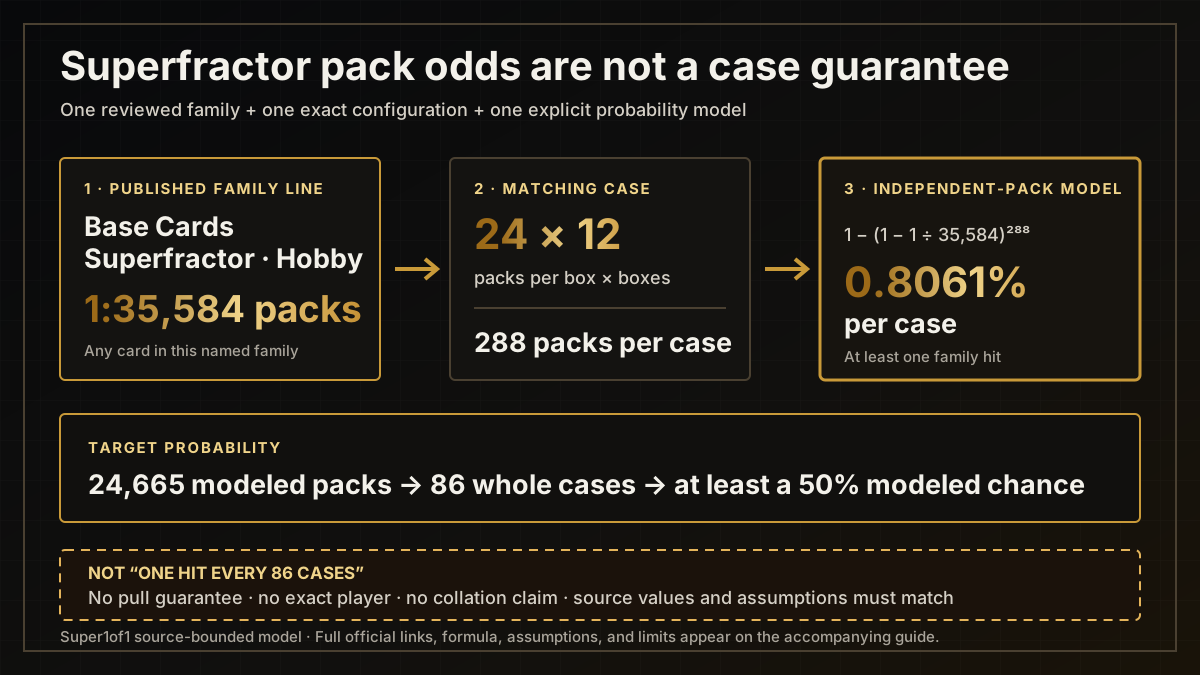
No finite case count guarantees a pull under ordinary published odds. First confirm that the odds denominator is per pack. Then use the official packs-per-box and boxes-per-case values for that exact configuration. Packs per case equals packs per box × boxes per case; the chance of at least one family hit in a case is 1 − (1 − 1 ÷ odds denominator)packs per case. The calculator applies the same stable formula and rounds a target up to whole cases.
Official 2024 Topps Chrome Hobby example
The reviewed odds table lists the Base Cards Superfractor Hobby family at 1:35,584 packs. Topps's matching 2024 Topps Chrome Baseball Hobby sealed-case page publishes 24 packs per box and 12 boxes per case, or 288 packs per case. Under the calculator's independent-pack model, one full case has a 0.8061% chance of at least one family hit. The model reaches at least a 50% chance after 24,665 packs, which rounds up to 86 whole cases.
That result does not say one Superfractor appears every 86 cases, guarantee the 86th case, identify a player, or establish factory collation. It models any card from the one reviewed family and configuration. Different rows, formats, releases, case sizes, rounded odds, or allocation rules require separate inputs and can produce different results.
When the math must remain unresolved
Do not publish a precise total when official sources leave a material gap. Common blockers include an odds family without an enumerated checklist, multiple configurations with unclear allocation, a product name reused across editions, contradictory source versions, or a parallel line whose scope is not defined. Super1of1 records that state as blocked pending official documentation rather than filling the gap from a listing or crowd estimate.
Common counting traps
| Trap | Why it produces the wrong answer |
|---|---|
| Counting one per player | A player can have distinct base, insert, autograph, relic, and variation identities. |
| Counting every checklist entry | Some card families may not be eligible for a Superfractor. |
| Counting family names instead of cards | One eligible family can contain hundreds of exact identities. |
| Treating four printing plates as Superfractors | Plate colors are distinct one-of-one objects with a different official identity and are outside this census. |
| Multiplying odds across every format | Hobby, retail, breaker, regional, or exclusive configurations can use different pools and denominators. |
| Using seller titles as checklist rows | Marketplace listings count as sightings, but seller wording does not define official checklist membership, eligibility, or print run. |
What a census total means
Super1of1 separates expected cards from surfaced copies. A published set total counts source-reviewed, eligible checklist identities. Seen coverage counts accepted public sightings matched to those identities, including fresh official-API marketplace sightings and reviewed independent evidence. Unmatched accepted marketplace items appear as provisional observed cards and do not change the published set total.
Browse published Superfractor checklists, build one exact card-family rainbow, or learn why a card with no accepted sighting is not proven unpulled or still in packs. Then use the calculator below only with a published odds line for one exact pack configuration. The current census scope is true Topps and Bowman baseball Superfractors from 2024 onward.
Original research tool
Superfractor pack and case odds calculator
Enter one published family-level Superfractor odds line for one exact pack configuration. The model estimates probability; it does not identify a card, prove collation, guarantee a case hit, or calculate a product's print run.
Read the result narrowly
- The formula models independent packs with the same published probability.
- Expected hits are a long-run average, not a promise for a box, case, break, or purchase.
- Rounded odds, collation, separate formats, redemptions, exclusions, or split allocations can make real products behave differently.
- A family-hit probability does not reveal which exact Superfractor would appear, whether it has surfaced before, or how many copies remain in sealed product.