Superfractor Rainbow Checklist & Free CSV Tracker
Build single- or multi-year Superfractor rainbow checklists from official sources, preserve future gaps, calculate completion, and download a private CSV.
A Superfractor rainbow is a collector-defined run of parallels for one precisely scoped card identity or family, usually ending with its Superfractor 1/1. Topps describes a parallel rainbow from base Refractor to Superfractor 1/1, but there is no universal list that applies to every release, card family, or box configuration. A useful rainbow checklist therefore begins with official product sources and a written scope—not a remembered color ladder or marketplace search.
Quick answer
Choose one exact card family or manufacturer-defined multi-year program. For every parallel, retain its release year, product or edition, program class or cohort, official source, and source status. Only a named, in-scope parallel documented for an exact release enters the confirmed denominator. Base cards, autographs, inserts, image variations, printing plates, and other editions enter the project only if your written scope says they do; they must never be silently treated as interchangeable.
Build a private rainbow tracker after defining that exact scope.
Define one exact identity before listing colors
Topps defines a Superfractor as the single 1-of-1 copy of a given card in the product. “Given card” is the controlling unit. A player's base card, autograph, insert, relic, and image variation can be separate checklist identities with different parallel structures and separate Superfractors.
| Scope field | Record before building the checklist | Why it changes the rainbow |
|---|---|---|
| Release | Year, manufacturer, brand, product, edition, and geography | Similar product names can carry different checklists and parallels. |
| Card family | Base, insert, autograph, relic, variation, or named subset | Each family can have its own eligibility and parallel ladder. |
| Exact identity | Card number, subject, image or variation marker, and identity-changing attributes | A player name alone can collapse several different cards. |
| Configuration | Hobby, jumbo, retail, mega, breaker, online, regional, or other documented format | Some parallels are format-exclusive while others share an allocation. |
| Source state | Official URLs, source date or version, access date, and unresolved conflicts | A later checklist or odds revision can change the candidate inventory. |
A rainbow name is not a universal scope
Collectors use “rainbow,” “true rainbow,” “mini rainbow,” and “master rainbow” differently. Those hobby labels do not replace a declared inventory. A defensible project says what it includes, what it excludes, and which official sources support that boundary.
| Working scope | Possible boundary | Required disclosure |
|---|---|---|
| Card-family rainbow | Every documented parallel of one exact base, insert, autograph, relic, or variation identity | Name the family and exact checklist entry. |
| Configuration rainbow | Only parallels documented for one box or pack configuration | Name the configuration and omit other exclusives explicitly. |
| All-configuration rainbow | Every documented parallel for the exact identity across all applicable configurations | Reconcile duplicates, shared pools, and exclusives across every source. |
| Color or scarcity run | A chosen subset, such as one finish per color or only numbered cards | Call it a partial scope rather than implying every parallel is present. |
| Master or player project | Several card families, variations, autographs, inserts, editions, or products | Keep each identity and its completion calculation separate. |
Can a Superfractor rainbow span multiple years?
Yes, when the manufacturer defines an evolving program and the worksheet preserves each release as a separate identity. The official 2026 Topps Chrome Baseball product page and Cooperstown Calls program article describe a seven-year program in which Hall of Fame classes return in newly introduced parallel colors. The current sources document a Blue Refractor /150 for the 2026 class and a Green Refractor /99 for the returning 2025 class. Those are two release-specific facts, not permission to invent the remaining years.
| Program evidence | Safe worksheet treatment | What remains outside the denominator |
|---|---|---|
| Manufacturer names a multi-year structure | Declare one program scope, then give every row its own release year, product or edition, and class or cohort. | Unspecified future colors, print runs, configurations, and card-family eligibility. |
| Current source names Blue /150 for the 2026 class | Record a 2026 class row with the exact official source and reviewed date. | Other 2026-class parallels not named by the reviewed program source. |
| Current source names Green /99 for the returning 2025 class | Record a separate returning-class row tied to the 2026 release. | Later returns of that class until an exact release source documents them. |
| Program says later years will add colors | Keep a private placeholder marked not documented for release or announced future, as the source supports. | Any assumed future Superfractor, year, color, odds, print run, or released-card claim. |
As reviewed on 2026-07-16, these official program sources do not name a future Superfractor, its year, or its print run for Cooperstown Calls. A seven-year promise establishes the program shape; it does not create seven released checklist rows or seven canonical census cards.
What if the Superfractor has not been documented for release?
Keep it as a future source gap marked not documented for release, not as missing, unpulled, expected, or released. It stays unresolved and outside the completion denominator until an official source names Superfractor eligibility for the exact release and card family. A marketplace title, image, presale, checklist repost, or collector prediction cannot fill that official-source gap.
What belongs on the candidate inventory?
| Candidate | Default treatment | Evidence question |
|---|---|---|
| Base card | Optional foundation; it is not itself a parallel | Does the written project scope include the base card? |
| Standard Refractor | Include when official sources document it for the exact family | Is it named and eligible in this release and configuration? |
| Colored or patterned Refractor | Each official name is a separate candidate | Are Red and Red Wave, for example, distinct entries even when both are /5? |
| Superfractor 1/1 | Include when the exact family is officially eligible | Does the source name Superfractor rather than another 1/1? |
| Image variation | Separate family unless the official structure explicitly says otherwise | Does it have its own checklist identity and parallel eligibility? |
| Autograph, relic, or insert | Separate family, not an automatic extension of a base-card rainbow | Does it use the same card number, image, attributes, and parallel list? |
| Printing plate | Separate 1/1 object; include only by declared collector choice | Is the plate officially listed, and are its cyan, magenta, yellow, and black identities distinct? |
| Sapphire, Logofractor, Update, or another edition | Separate release unless the project explicitly spans editions | Does the manufacturer treat it as the same product and checklist family? |
Why there is no safe universal color ladder
Official products demonstrate the problem. The 2026 Topps Chrome Black Baseball guide lists a base-family ladder beginning at Refractor /199, then several color, Mini-Diamond, and Wave variants before the Superfractor 1/1. Its inserts and autograph subsets use shorter, different ladders. In contrast, the 2025 Topps Gilded Collection Baseball page describes an all-gold base rainbow whose patterns replace traditional color variations and whose base cards are already numbered to 99.
These examples illustrate a method, not a reusable checklist. Never copy their parallel names or print runs into another release. Even repeated names such as Gold, Red, Wave, Mini-Diamond, or Superfractor must be verified against the exact family and source version under review.
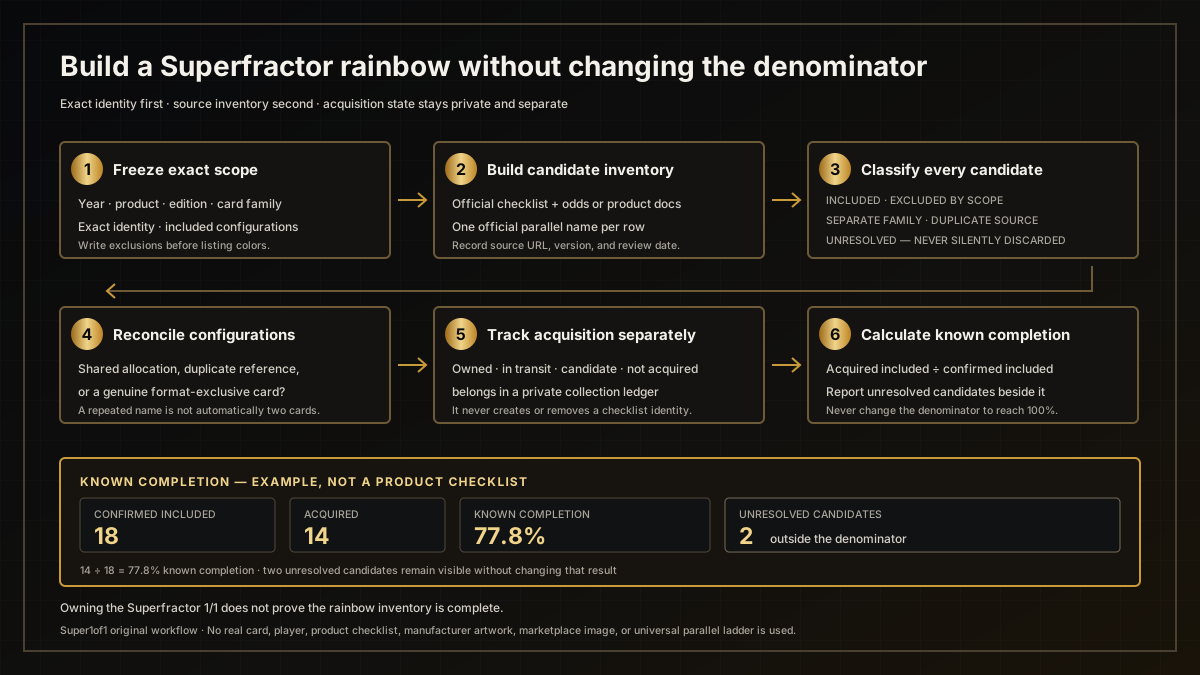
Seven-step Superfractor rainbow checklist method
- Freeze the project scope. Write the exact single release or manufacturer-defined multi-year program, family, identity, configurations, and whether the base card, plates, variations, autographs, inserts, or other editions count.
- Open the official checklist. Use the Topps checklist library or the manufacturer's equivalent to confirm the exact card number, subject, set or subset, and identity attributes.
- Collect every applicable official parallel source. Review odds sheets, product pages, sell sheets, and documented configuration variants. Record direct URLs, exact release identity, and access dates rather than copying the source documents.
- Build a candidate inventory. Give every official parallel name and release its own row. Preserve year, class or cohort, color, pattern, numbering, and configuration distinctions even when two rows have the same print run.
- Classify source and scope separately. Mark whether the row is documented for an exact release, announced future, not documented, or unresolved; then mark it included, excluded by scope, separate family, duplicate source reference, or unresolved. A marketplace title cannot resolve an official-source gap.
- Reconcile across releases and configurations. Determine whether a repeated name is one shared parallel distributed across formats or a distinct release-specific card. Leave the row unresolved when the sources do not say.
- Track collection state separately. Record owned, in transit, candidate, or not acquired only in a private collection ledger. Accepted fresh listings can supply public sightings, but they do not create checklist identities or prove ownership.
Completion math must preserve unresolved candidates
Known completion equals acquired included entries divided by entries that are both in scope and documented for an exact release. If official review confirms 18 entries and the collector has 14, known completion is 14 ÷ 18 = 77.8%. If two additional candidates remain unresolved, announced for a future release, or not documented for release, do not add them silently, discard them to reach 100%, or claim the project is complete. Publish the known calculation and the unresolved count separately.
Acquiring the Superfractor does not prove the inventory is complete. It establishes possession of one included entry under the collector's stated scope. Completion still depends on a complete, correctly reconciled parallel inventory; current custody and authenticity also require evidence beyond a checklist row.
Common Superfractor rainbow mistakes
| Mistake | Safer practice |
|---|---|
| Using last year's color list | Rebuild from the exact release's current official sources. |
| Turning a multi-year program announcement into a future checklist | Record only exact release facts; keep unspecified future slots outside the denominator. |
| Counting one entry per print run | Preserve separately named parallels such as Red and Red Wave even if both are /5. |
| Combining base and autograph cards because the subject matches | Keep different card families and identity attributes in separate inventories. |
| Calling every gold 1/1 the Superfractor | Require the official Superfractor name and exact-family eligibility. |
| Using a marketplace search as the checklist | Use listings only as temporary discovery leads after the official inventory exists. |
| Removing a parallel because no copy has surfaced | Separate checklist expectation from public evidence and private acquisition. |
| Calling the rainbow complete while sources conflict | Show the confirmed denominator and unresolved candidates separately. |
Reusable Superfractor rainbow worksheet
Keep one row per release-specific parallel and one worksheet per exact card family or manufacturer-defined program. The local builder below calculates known completion while preserving future and unresolved source gaps, and can download the inventory as a CSV without sending it to Super1of1.
Project name:
Scope statement:
Single release or manufacturer-defined program:
Set or subset / card number / subject:
Base, insert, autograph, relic, or variation family:
Configurations included:
Base card included: yes / no
Printing plates included: yes / no
Other editions or families included: yes / no
Official checklist URLs / versions / reviewed dates:
Official odds or product URLs / versions / reviewed dates:

Release year | product or edition | program class or cohort | parallel name | print run or odds | configuration | official source | official release status | classification | private collection state | notes

Confirmed included entries documented for an exact release:
Acquired included entries:
Known completion percentage:
Unresolved, announced-future, or not-documented entries:
Excluded or separate-family entries and reasons:
Next source needed:
Download the blank rainbow CSV
The blank file contains only worksheet headings. It downloads directly to your device; Super1of1 does not receive, upload, or store what you add.
Shareable scope statement
This project covers every officially documented [parallel family] parallel of [single release or manufacturer-defined program / set or subset / card number / subject] across [configurations]. Every included row is tied to its exact release; future source gaps remain outside the denominator. The project [includes / excludes] the base card, printing plates, image variations, autographs, inserts, relics, and other editions. The inventory was reviewed against [official sources] on [date]. Confirmed completion is [owned] of [included] entries; [count] candidates remain unresolved.
Source review and Super1of1 boundaries
This worksheet was reviewed against manufacturer-published pages available on 2026-07-16. It stores factual methods and source links, not Topps checklists, odds documents, card images, or a universal parallel database. Product pages can change; reopen every source and record the current version before claiming completion.
Use the parallel comparison guide to classify confusing 1/1s, the 1st Bowman identity guide to separate prospect, rookie, and autograph families, and the quantity and odds guide to count eligible identities. Super1of1 does not authenticate cards, verify private ownership, broker rainbow purchases, or expand its canonical census beyond true Topps and Bowman baseball Superfractors from 2024 onward.
Original research tool
Build a private Superfractor rainbow worksheet
Add one row per documented parallel or future source gap, classify its release and scope states explicitly, and download a CSV for your own records. Only in-scope rows documented for an exact release enter the completion denominator. Everything runs in this page; nothing is submitted, uploaded, or stored by Super1of1. Spreadsheet formulas are neutralized during export.