Sports Card Serial Number Reader: Superfractor & 1/1
Read 10/25, 1/1, -1/0, and 1:1 odds; compare Superfractors with Nebula, Black Finite, printing plates, and other one-of-ones.
Original research tool
Sports card serial-number reader
Enter the complete slash notation exactly as it appears. This reader explains the characters; it does not search a registry, identify a parallel, authenticate a stamp, estimate value, or save a result to the census.
Read the result narrowly
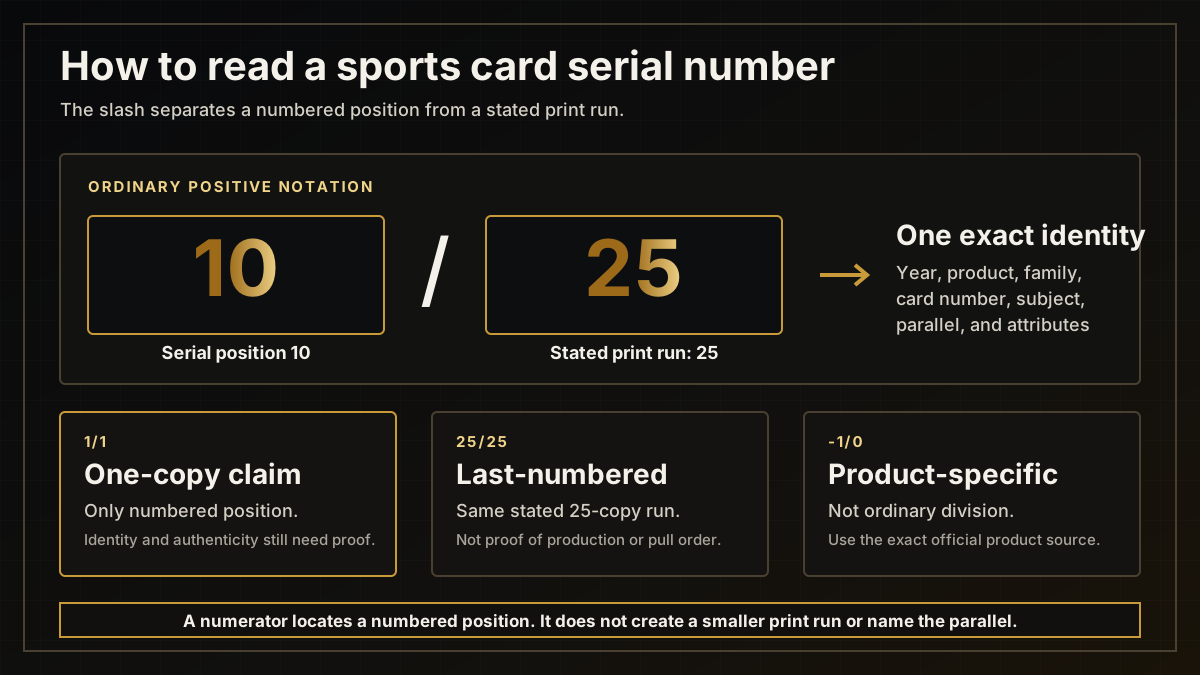
- For ordinary positive notation, the left number is the sequential position and the right number is the stated print run for one exact identity.
- Position 1/25 is first-numbered and 25/25 is last-numbered within the same stated 25-copy run. Neither position proves manufacturing, packing, sale, or pull order.
- Collector labels such as bookend, jersey-numbered, or “eBay 1/1” do not change the manufacturer-stated denominator or create another one-copy identity.
- A denominator does not supply the release, card number, parallel name, autograph or relic state, authenticity, condition, price, or ownership.
- Negative sequences such as -1/0 are product-specific labels rather than division. Use the exact manufacturer's source before interpreting them.
A 1/1 sports card is the sole stated copy of one exact manufacturer-issued card identity. The slash reads “of”: copy one of a stated one-copy print run. It does not mean the player appears on only one card, the product contains only one 1/1, or the card is automatically a Superfractor. The year, product, card family, card number, subject, parallel, and identity-changing attributes determine what the one-copy claim actually covers.
Quick answer
Read 1/1 as a print-run claim, then identify the exact card that claim modifies. Every true Superfractor is a manufacturer-issued one-of-one, but Platinum and Platinum Holo Foil parallels, printing plates, Rookie Debut Patch Autos, Foilfractors, sketch cards, and other named 1/1s keep their own identities. A seller title, holder label, handwritten inscription, product name, or gold pattern cannot supply the missing manufacturer classification.
What does 1/1 mean on a sports card?
Topps's numbered-card definition explains that a notation such as 10/100 identifies the tenth sequentially numbered card in a stated 100-copy print run. On a manufacturer-issued 1/1, the serial position and stated print run are both one. The claim belongs to that complete card identity—not to every card of the subject, every parallel in the product, or every object that later copies its design.
| Notation or claim | Safe reading | Required follow-up |
|---|---|---|
| 10/25 printed on the card | The card claims serial position 10 within a stated 25-copy run of that exact identity. | Match the product, card family, parallel, and official documentation; the denominator does not name the parallel. |
| 1/1 printed on the card and supported by matching official sources | One stated copy of that exact card identity. | Verify the physical card and every identity-changing field separately. |
| 1/1 printed on the card but the checklist or product documentation conflicts or omits the family | An unresolved one-copy claim. | Preserve the conflict; do not borrow eligibility from a similar card or create a canonical identity. |
| 1/1 appears only in a listing title, holder label, autograph inscription, or custom graphic | A description or later-added claim, not proof of a manufacturer print run. | Find the original manufacturer identity and product source before classifying it. |
| -1/0 or another unusual sequence | Product-specific notation, not a mathematical statement about copies. | Transcribe every character and use that release's documentation before interpreting scarcity. |
Do bookends or jersey-numbered cards become 1/1s?
No. Collector labels can describe a serial position or a coincidence between the numerator and a subject's uniform number, but they do not change the manufacturer-stated denominator. Only a supported one-copy identity has a stated print run of one.
| Example label | What the notation supports | What it does not support |
|---|---|---|
| 1/25, first-numbered or bookend | Serial position one in a stated 25-copy run. | First produced, packed, sold, or pulled; a smaller print run; or an automatic value premium. |
| 25/25, last-numbered or bookend | Serial position 25 in the same stated 25-copy run. | Last produced, packed, sold, or pulled; a separate parallel; or a one-of-one. |
| 17/99 called jersey-numbered when the subject wears 17 | Serial position 17 in a stated 99-copy run, plus a collector-applied description when the identity match is accurate. | A manufacturer one-of-one, a different checklist identity, or a guaranteed premium. |
| “eBay 1/1” or another listing-only phrase | A marketplace claim that may describe availability, a numbering coincidence, or promotion. | A printed one-copy run, official parallel name, authenticity, or census eligibility. |
What a 1/1 does and does not prove
| Question | Does a supported 1/1 claim answer it? | Why |
|---|---|---|
| What is the stated print run of this exact identity? | Yes: one copy. | Only after the serial claim, exact identity, and applicable official sources agree. |
| Is the official name Superfractor? | No. | Superfractor is one named Refractor parallel; other manufacturer one-of-ones use other names. |
| Is it the player's only 1/1? | No. | Distinct base, autograph, insert, variation, relic, and other identities can each have a separate one-copy version. |
| Is the physical card authentic and unaltered? | No. | A print-run notation does not authenticate card stock, printing, autograph, patch, serial stamp, or holder. |
| Is it valuable, sold, or owned by the person showing it? | No. | Scarcity does not establish demand, condition, transaction completion, legal title, custody, or permission to sell. |
| Has the copy been publicly seen? | No. | That requires an accepted public sighting matched to the canonical identity; the 1/1 notation supplies no observation history. |
A Superfractor is a Refractor, but an ordinary Refractor, Gold Refractor, or X-Fractor is not automatically a Superfractor. Topps defines a Refractor by its prism or rainbow-like printing effect and a Superfractor as the rarest type: the single 1-of-1 copy of a given card. The official parallel name and the print run answer different questions, and both must match the exact checklist identity.
Superfractor vs. Refractor at a glance
| Official classification | Scarcity | What the name establishes | Super1of1 census |
|---|---|---|---|
| Standard Refractor | Product-specific; may be numbered or stated only as pack odds | The standard prism or rainbow-like Refractor parallel for that card family | Outside scope unless the exact source names it Superfractor |
| Gold or other color Refractor | Product-, family-, and sometimes configuration-specific | A named color parallel, not a universal serial-number tier | Outside scope unless the exact source names it Superfractor |
| X-Fractor or other patterned Refractor | Product- and configuration-specific | A named patterned alternative to the standard Refractor | Outside scope unless the exact source names it Superfractor |
| Frozenfractor | Product- and family-specific; a Topps example uses five negative-numbered copies | Its own named icy parallel and numbering convention | Outside scope |
| Superfractor | One copy for the exact identity | The officially named 1/1 Superfractor parallel | In scope after complete source review |
| Padparadscha Sapphire 1/1 | Product- and family-specific; official Topps examples are 1/1 | Its own named Sapphire parallel, not a synonym for Superfractor | Outside scope |
| Platinum or Platinum Holo Foil 1/1 | Product- and family-specific; official Topps examples can be 1/1 | Its own named parallel, not a synonym for Superfractor | Outside scope |
| Rookie Debut Patch Auto | Official Topps examples are 1/1 | Its own debut-linked autograph and memorabilia card identity, not a Refractor parallel | Outside scope |
| Foilfractor | Product- and family-specific; official Topps examples can be 1/1 | Its own named foil parallel, not a synonym for Superfractor | Outside scope |
| Black Finite | Product- and family-specific; the cited 2020 Panini Prizm Football example is #/1 | Panini's named parallel for the exact documented family, not a Topps or Bowman Superfractor | Outside scope |
| Nebula | Product- and family-specific; official Panini examples include both #/1 and #/2 | Panini's named parallel for the exact documented family, not a universal one-copy tier or a Superfractor | Outside scope |
| Gold Vinyl | Product- and family-specific; the name does not guarantee 1/1 | Its manufacturer's named parallel, not a Topps or Bowman Superfractor | Outside scope |
| Printing plate | Often one per plate color and exact identity | The production plate and its named color identity | Outside scope |
| Other manufacturer 1/1 | One copy for the exact identity | Its own named parallel, insert, autograph, relic, sketch, or other identity | Outside scope |
Superfractor vs. a standard Refractor
Topps says products can contain multiple Refractor types and that their colors can have different quantities. Its True Refractor definition uses “true” for the standard Refractor parallel in products such as Bowman Chrome and Topps Chrome, distinguishing it from color and patterned alternatives. A standard Refractor therefore identifies a finish and a place in a product's parallel structure; its name alone does not mean 1/1.
Superfractor vs. Gold Refractor
A Gold Refractor is not automatically /50. That numbering is common in some card families, but it is not a definition that can be transferred to every release. The official 2024 Topps Finest Baseball product breakdown provides a useful counterexample within one release: Base Common Gold Refractors are numbered to 50, Base Uncommon Gold Refractors to 25, and Base Rare Gold Refractors to 20. The corresponding Superfractors remain 1-of-1.
Gold describes the named color parallel; Superfractor describes the separately named one-copy parallel. Check the exact card family in the official checklist and odds instead of filling in a familiar rainbow from memory.
Superfractor vs. X-Fractor and patterned Refractors
Topps lists X-Fractors, Prism Refractors, and Sepia Refractors as alternatives to the standard Refractor in some products. The X-Fractor name does not supply one universal print run: a release may express availability through a serial number, pack odds, box exclusivity, or another product-specific rule. A pattern can help identify a candidate card, but the official product source decides its name and scarcity.
Superfractor vs. Frozenfractor and negative-numbered cards
A Frozenfractor is a separate named parallel, not a Superfractor, a one-of-one, or a printing error merely because its serial number is below zero. Topps's official 2024 Topps Chrome Baseball Frozenfractor explanation identifies five copies of each eligible card, numbered -1/0, -2/0, -3/0, -4/0, and -5/0. In that product, “-1/0” identifies one member of a five-copy parallel; it does not mean that zero copies exist or that the card is 1/1.
The parallel name remains decisive. The official 2024 Topps Chrome Update Series product breakdown lists Negative, FrozenFractor, SuperFractor, and Printing Plates as separate base-card treatments. It describes the FrozenFractor as numbered to -5, while the SuperFractor and each printing plate are separately listed as 1/1. A “Negative Refractor” name is therefore not evidence that a card is a Frozenfractor, either.
How to read a negative serial safely
- Transcribe the full serial exactly, including both sides of the slash and every minus sign.
- Match the release, card family, configuration, and official parallel name.
- Use that product's official checklist, odds, or product explanation to determine how many copies the sequence represents.
- Record Frozenfractor, Superfractor, Negative Refractor, and printing plate as different identities even when they share a subject and card number.
Do not transfer the 2024 Baseball five-copy example to every product that uses Frozenfractor technology. A later release, autograph family, or different sport can define availability differently. If the exact official source does not resolve the sequence, preserve the printed serial as an observation and leave the print run unresolved. Frozenfractors remain outside the Super1of1 census unless a separate exact checklist identity is officially named Superfractor and numbered 1/1.
Why every Superfractor is 1/1 but not every 1/1 is a Superfractor
Topps describes a one of one as the rarest type of trading card, but the 1/1 notation still states scarcity rather than the complete card name. “Superfractor” names one particular Refractor parallel. Printing plates, sketch cards, unique autographs, and other manufacturer 1/1s keep their own identities.
Is a Topps buyback 1/1 a Superfractor?
No—not from “buyback” or “1/1” alone. Buyback describes a relationship between an earlier physical card and a later manufacturer program. A serial number describes the stated print run of one complete later identity. Neither term supplies the Superfractor parallel name.
Topps's official 2025 Archives Signature Series Active Player guide describes one encased certified autograph on a buyback version of a past Topps or Bowman card. The card receives a gold-foil Certified autograph stamp and is numbered to 99, while each player signs across multiple earlier cards and designs. The matching official release page identifies those objects as hand-signed, foil-stamped, serial-numbered buybacks. It does not rename the family Superfractor.
Do not confuse a serial fraction with insertion odds. The official 2025 Archives Signature Series odds linked by Topps list Autographed Buybacks at 1:1. In the cited one-card-per-pack configuration, the colon means one card from that category per pack. It is not a slash, does not mean every card is serial-numbered 1/1, and does not name a Superfractor.
| Observed field | What it identifies | What it does not establish |
|---|---|---|
| Original year, product, and card number | The earlier card used as the physical starting point | The complete identity of the later buyback autograph release |
| Certified autograph stamp and later release year | The later manufacturer-issued buyback autograph layer | That the earlier card was originally autographed or a Superfractor |
| 1/1 serial on the later card | One stated copy of that complete later buyback identity | That its official parallel name is Superfractor |
| 1:1 in product odds | One Autographed Buyback per pack in the cited configuration | A serial denominator, one copy per player, or a one-of-one card |
| Marketplace or holder shorthand | A temporary description of one or both identity layers | Manufacturer classification, authenticity, or census eligibility |
Topps's 2026 Iconic Topps Buybacks program confirms that buyback is not one universal physical treatment. That program uses graded original cards without a buyback stamp, delivers them through redemption, and expressly excludes the original 1/1 cards on its published list. Autograph, stamp, holder, redemption, and serial rules therefore have to come from the exact buyback program rather than from the word alone.
Census rule for a buyback 1/1
A later buyback autograph numbered 1/1 does not enter the Super1of1 census unless applicable official sources name that exact later identity Superfractor 1/1. If the reused earlier card is itself an independently established Superfractor, retain both identity layers and record the later autograph, stamp, holder, or reissue relationship as physical history. The later numbering neither creates a second canonical Superfractor nor erases the earlier identity, and a listing or holder cannot resolve either layer.
Superfractor vs. Rookie Debut Patch Auto (RDPA)
A Superfractor and a Rookie Debut Patch Autograph can both be manufacturer-issued 1/1 cards without being the same type of card. Topps's Rookie Debut Patch Auto FAQ defines its 2023 Topps Chrome Update example as a 1/1 with the player's on-card autograph and the Debut Patch from the player's game-worn uniform. Those attributes establish a dedicated autograph and memorabilia identity. A Superfractor instead requires the officially named one-copy Refractor parallel for its exact checklist family.
| Identity question | Superfractor | Rookie Debut Patch Auto |
|---|---|---|
| Official card type | A named Refractor parallel | A named autograph and debut-patch memorabilia card |
| What the 1/1 applies to | One copy of the exact eligible Superfractor parallel identity | One copy of the exact eligible RDPA identity |
| Required source match | Exact checklist family plus official Superfractor eligibility and 1/1 print run | Exact RDPA checklist entry plus the applicable official product and patch documentation |
| Super1of1 census | In scope after complete source review | Outside scope even though it is a true one-of-one |
Topps makes the separation especially explicit in its current Three Kings program description: it lists a Rookie Debut Patch Auto, a Bowman Chrome 1st Superfractor Auto, and a Topps Chrome Rookie Superfractor Auto as three separate required cards for the same player. One does not duplicate, replace, or rename another. A sale price, collector preference, or “best card” claim cannot change those manufacturer identities.
Do not classify a card from an RC logo, “rookie debut” wording, patch window, autograph, hologram, or 1/1 stamp alone. Match the exact year, product, card family, card number, subject, and official name. If the official checklist and product sources do not establish an RDPA or Superfractor identity, leave the claim unresolved. Super1of1 does not authenticate a physical patch, autograph, or card and does not add Rookie Debut Patch Autos to the canonical Superfractor census.
Is a printing plate 1/1 a Superfractor?
No. Topps defines a printing plate as a thin metal plate used to print cards. Its definition says plates are typically cyan, magenta, yellow, and black and are often offered as one-of-one collectibles. A supported 1/1 statement therefore belongs to one exact plate-color identity; it does not prove that every release made or offered all four colors. The production object, color, and official name remain different from a Superfractor.
The official 2025 Bowman Baseball product guide makes the separation explicit. Its Chrome Prospect Refractor, Chrome Prospect Autograph, and Chrome Rookie Autograph parallel lists each name Superfractor and Printing Plates as separate 1/1 entries. The official 2025 Bowman odds likewise give those categories separate rows. One exact family can therefore support both identities without either one becoming the other.
| Identity question | Superfractor 1/1 | Printing plate 1/1 |
|---|---|---|
| What is it? | The officially named one-copy Refractor parallel for an exact eligible card identity | A production plate with its own named color and exact card identity |
| What does 1/1 mean? | One stated copy of that exact Superfractor identity | One stated copy of that exact plate-color identity when the applicable source supports it |
| Can both exist for the same card family? | Yes, when the exact product sources list both categories separately | Yes; coexistence does not combine their names or copy counts |
| Does appearance settle the identity? | No; match the exact checklist family, parallel name, 1/1 statement, and physical card | No; metal stock or a plate color is a research cue, not complete source reconciliation or authentication |
| Super1of1 census | In scope after complete source review | Outside scope even when it is a genuine manufacturer one-of-one |
For a release review, use the official Topps checklist library to establish the card and family, then the official odds library or comparable manufacturer documentation to establish which one-of-one categories apply. The 2025 Bowman example proves only those cited families; it is not a universal four-plate rule or evidence that every checklist entry receives both categories.
Census rule for a printing plate 1/1
A printing plate remains outside the canonical Superfractor census. A neighboring Superfractor row cannot rename the plate, and a neighboring plate row cannot establish Superfractor eligibility. Marketplace titles, holder labels, prices, images, or seller claims do not change either identity. Only an exact card family officially supported as a Superfractor 1/1 can enter the census; accepted exact-match public sightings then contribute to its seen coverage.
Superfractor vs. Platinum 1/1 and Topps flagship one-of-one cards
A Platinum, Platinum Holo Foil, or other flagship one-of-one is not automatically a Superfractor. “1/1” establishes the stated copy count for one exact identity; the official parallel name establishes which one-of-one it is. The card remains a Platinum, Foilfractor, printing plate, or other named one-of-one unless the applicable product source names that exact family Superfractor.
The official 2025 Topps Baseball Series 1 product guide shows why the names cannot be collapsed. Within one release, it separately lists Base Set Platinum Holo Foil #1/1, Base Set Foilfractor 1-of-1, Printing Plates 1-of-1, Base Card Birds 1/1, Spring Training Platinum 1/1, insert Foilfractors 1/1, and autograph Platinum or Foilfractor 1/1 parallels. The same product can therefore contain several separately named one-of-one families. Eligibility still has to be checked for the exact set, subset, subject, and configuration.
| Official phrase | Safe identity reading | What not to infer |
|---|---|---|
| Platinum Holo Foil #1/1 | A named Topps flagship base-set parallel with a stated one-copy run in the cited release | That it is a Refractor or Superfractor |
| Foilfractor 1-of-1 | A separate named foil parallel with a stated one-copy run | That Foilfractor and Superfractor are interchangeable |
| Printing Plate 1-of-1 | A separately named production plate identity | That one player has only one plate or one total 1/1 |
| Superfractor 1-of-1 | The officially named one-copy Refractor parallel for an exact eligible family | That another 1/1 in the release shares its identity |
Is Topps Chrome Platinum the same as a Platinum 1/1?
No. Topps Chrome Platinum is a product name. Topps describes 2025 Topps Chrome Platinum Baseball as an extension of the Topps Chrome brand using Chrome technology, while the official odds linked from that page separately list Base Superfractor and additional Superfractor families. “Platinum” in the product title neither makes every card a Platinum parallel nor prevents an exact eligible card from having a Superfractor. Use that product's checklist and odds to identify the card family and parallel.
Is a Golden Mirror variation a Superfractor or 1/1?
No—not from the Golden Mirror name or SSP stamp. Topps's official 2023 Golden Mirror introduction defines the cards as super short print image variations: every Series 1 base-set subject receives a Golden Mirror identity with different front photography, golden back artwork, and a gold-foil SSP stamp. The source does not call that identity a Superfractor or state a 1/1 serial number. “SSP” describes a scarce issue in that product; it is not a numeric denominator that can be rewritten as one.
Image variation and parallel are separate identity fields. The official 2025 Topps Chrome Baseball product guide, for example, lists Chrome Homefield Advantage Image Variations as a family and then lists a SuperFractor 1/1 within that family's parallel ladder. That exact card would be both an image-variation identity and its Superfractor parallel. This does not turn a flagship Golden Mirror SSP—or every image variation—into a Superfractor.
| Official example | Variation or family identity | Parallel or scarcity statement | Safe result |
|---|---|---|---|
| 2025 Topps Baseball Update Series base cards | Golden Mirror Image Variation | SSP; no 1/1 statement in the cited list | Golden Mirror SSP, not a Superfractor or one-copy claim. |
| Same 2025 Update base set | Base-card parallel identities | FoilFractor 1/1 and Platinum Holo Foil 1/1 are separately named | The product's named one-of-ones do not rename its Golden Mirror variation. |
| Same 2025 Update autograph lineup | Flagship Real One Golden Mirror Autos | A separate autograph family; the shared words do not supply the base SSP identity or a universal print run | Record the autograph family and its own source facts separately. |
| 2025 Topps Chrome Baseball | Chrome Homefield Advantage Image Variations | SuperFractor 1/1 is expressly listed for that exact family | Variation plus officially named Superfractor 1/1; potentially in scope only after complete release review. |
Five fields that settle the classification
- Release and product: flagship, Chrome, Update, and another edition do not share one parallel map.
- Card family: identify the base, image variation, insert, autograph, relic, or other exact family.
- Official identity name: transcribe Golden Mirror, Homefield Advantage Image Variation, Real One Golden Mirror Auto, or the applicable source wording without shortening it.
- Layered parallel: verify whether that exact family has a separately named Superfractor or another parallel.
- Scarcity evidence: retain SSP, pack odds, and a printed or published serial denominator as different facts. Only an exact, officially supported Superfractor 1/1 can enter this census.
What is a “true 1/1” sports card?
There is no single manufacturer-independent definition of “true 1/1.” A supported 1/1 states that one exact card identity has a one-copy print run. The added word “true” can instead describe origin, checklist status, a base or headline position, a design with no parallel counterpart, unique physical content, or simply a collector's preference. State which meaning you intend and verify it separately; “true” cannot replace the official card name.
Official usage is context-specific. Topps's 2025-26 Topps Chrome Basketball pull review describes both Superfractors and selected premium inserts as true one-of-one cards. Its Only1 program explanation uses a true-one-off idea for a card with no parallel, image variation, base card, or duplicate design. The 2025 Topps Baseball example above separately documents multiple named 1/1 families in one release. Those examples support their exact products; together they show why the word “true” does not create one universal cross-product identity class.
Two separate tests: one-copy identity and “true” scope
First ask whether official sources and the physical card support one stated copy of the complete identity. Then ask what the speaker means by “true” and whether a source supports that narrower origin, design, checklist, or relationship claim. Passing the second test cannot repair a failed first test, name a Superfractor, or choose one card as the player's only 1/1.
| Claim being made | Evidence to record | Safe public wording | What remains unproven |
|---|---|---|---|
| The card is a manufacturer 1/1 | Exact checklist identity, applicable official product or odds source, stated print run, and physical 1/1 agreement. | Manufacturer-issued 1/1 of the exact named identity, when every field agrees. | Pack origin, official Superfractor name, authenticity, condition, ownership, value, or public documentation. |
| “True” means checklisted and pack-issued | The original checklist entry, eligible configuration, pack-insertion source, and any redemption status. | Checklisted, pack-issued 1/1 only when both facts are directly supported. | That non-pack-issued rewards or replacements are counterfeit, worthless, or ineligible for their own official names. |
| “True” means the base or headline 1/1 | The exact base, insert, autograph, relic, or variation family and the claimant's stated comparison scope. | Base-set [official parallel] 1/1, or another exact manufacturer name. | A universal hierarchy, the player's only 1/1, greater pull difficulty, or a value premium. |
| “True” means no base, parallel, or duplicate design | A direct manufacturer description of that exact program and its design relationship. | The exact program name plus its documented no-counterpart design claim. | That every uniquely designed 1/1 is an Only1 card, a Superfractor, or inside this baseball census. |
| “True” means unique relic, art, or physical content | The exact named family, object-specific material or art claim, checklist scope, and stated print run. | The official insert, relic, sketch, or other card name followed by its supported 1/1 fact. | That the material is authenticated remotely, no related identities exist, or physical uniqueness supplies a Superfractor name. |
| A replacement, redemption, or reward is 1/1 | The issuing source, original and replacement or reward identities, issue reason, timing, and official one-copy statement. | The exact official card name, 1/1 status, and origin when each is documented. | Original pack insertion, checklist equivalence, substitution for another identity, or Superfractor census eligibility. |
| A listing, holder, or collector calls it “true 1/1” | The claimant's definition plus independent manufacturer and physical evidence. | Collector-described “true 1/1” claim, unresolved until its testable facts are supported. | Any manufacturer identity, print run, authenticity, ownership, sale, price, or census conclusion. |
Does “true 1/1” mean the player's only one-of-one?
No. A single release can contain multiple legitimate one-copy cards for the same subject across base, insert, autograph, relic, variation, plate-color, exclusive, reward, or other families. A no-counterpart design can also be one distinct identity without erasing those cards. Compare exact fields with the multiple-Superfractor identity method instead of applying uniqueness to the player.
Five checks before publishing a “true 1/1” claim
- Rewrite “true” as a testable sentence. Say checklisted, pack-issued, base-family, no counterpart, unique material, replacement, reward, or another specific meaning.
- Freeze the exact identity. Record release, product, edition, configuration, set or subset, card number, subject, attributes, and official name.
- Verify the one-copy fact. Reconcile the manufacturer checklist, product or odds source, stated print run, and physical 1/1 marking.
- Verify origin and relationships separately. Do not infer pack insertion, base-card status, redemption, replacement, reward, or no-counterpart design from the denominator.
- Publish the narrow result. Preserve conflicts and label collector preference as opinion. The word “true” has no effect on Super1of1 census eligibility; only an officially supported Superfractor 1/1 can qualify.
Blank true 1/1 claim-audit worksheet
Use one row per claimed card identity. The fields keep the one-copy fact, manufacturer name, origin, design relationship, collector definition, and Superfractor result separate.
Download the blank true 1/1 audit CSV
The header-only file downloads directly to your device; Super1of1 does not receive, upload, or store what you add. Do not enter an owner name, account credential, home or storage location, purchase amount, payment record, private message, redemption code, claim identifier, or unpublished document.
Padparadscha 1/1 vs. Superfractor in Topps Chrome Sapphire
A Padparadscha Sapphire 1/1 and a Superfractor can appear in Sapphire products without being the same parallel. Topps's official 2021 Bowman Chrome Sapphire product page explicitly lists Padparadscha Sapphire parallels numbered 1-of-1 for its base set and image variations. That is one product-specific example, not a universal Padparadscha rule.
The official 2024 Topps Chrome Update Series Baseball Sapphire product page names limited Padparadscha Sapphire Refractors and separately tells collectors to look for Superfractor parallels of select players. Its matching official odds make the separation concrete: Base Cards Superfractor Sapphire and Base Cards Padparadscha Sapphire are different rows, specified Sapphire Selections families use Superfractor, and the Chrome Sapphire Autographs family uses Padparadscha. Those sources establish separate family-level names; they do not establish that every checklist identity receives both one-of-ones. Neither the Sapphire product name nor a 1/1 stamp replaces the exact parallel and card-family match.
| Identity question | Padparadscha Sapphire 1/1 | Superfractor |
|---|---|---|
| What does the name establish? | The officially named Padparadscha Sapphire parallel for the exact eligible family | The officially named Superfractor parallel for the exact eligible family |
| What does 1/1 establish? | One stated copy of that Padparadscha identity | One stated copy of that Superfractor identity |
| Can the product name or appearance classify it? | No; “Sapphire,” color, pattern, or a seller title cannot replace the official family row | No; gold appearance, a 1/1 stamp, or a seller title cannot replace the official family row |
| Super1of1 census treatment | Outside scope even when it is a genuine manufacturer one-of-one | In scope only after the complete set and exact family pass source review |
Do not rank either card as the “real,” “true,” better, rarer, or more valuable one-of-one from the name alone. Record the exact year, release, Sapphire edition, set or subset, card number, subject, autograph or insert family, official parallel name, and stated print run. Super1of1 excludes a Padparadscha identity from the canonical census and never converts it into a Superfractor because an image, holder label, listing, or collector shorthand uses both names.
Superfractor vs. Black Finite, Gold Vinyl, and Foilfractor
A Black Finite 1/1 is not a Superfractor. Black Finite, Gold Vinyl, and Foilfractor are manufacturer-assigned parallel names, not alternate spellings of Superfractor. A circular, gold, foil, or vinyl-like pattern can be a useful visual clue, but appearance does not supply the manufacturer, official parallel name, card family, or print run. Use the exact product documentation before classifying the card.
| Official product example | What the source calls it | Safe conclusion |
|---|---|---|
| 2026 Topps Series 1 Baseball Celebration Mega Box | Foilfractor parallels numbered 1/1 in specified insert families | Those are manufacturer-issued Topps one-of-ones named Foilfractor, not Superfractor. |
| 2018 Panini Elite Extra Edition Baseball | College Tickets Signatures Gold Vinyl 1/1 | That exact Panini family uses Gold Vinyl for a one-copy parallel; it is not a Superfractor. |
| 2020 Panini Prizm Football product information | Base and Rookies Gold Vinyl /5, with Black Finite /1 | The Gold Vinyl name does not guarantee a 1/1 print run. Product and family documentation controls. |
In that 2020 Prizm Football appendix, Panini lists Base, Rookies, and Rookie Autographs Gold Vinyl as #/5 and the corresponding Black Finite parallels as #/1. The same document also lists Black Finite 1/1s in specified patch-autograph and signature families. Those facts apply to the cited product and families only; they do not establish Black Finite or Gold Vinyl numbering in another Panini release.
| Identity field | Topps or Bowman Superfractor | Panini Black Finite in the cited example |
|---|---|---|
| Manufacturer name | Superfractor | Black Finite |
| Documented scarcity | 1-of-1 for the exact eligible identity | #/1 for the exact listed 2020 Prizm Football family |
| If the same subject has both | They are two exact manufacturer-and-product identities, not duplicate copies of one universal 1/1. | |
| Can a listing or holder rename it? | No. Marketplace and holder language cannot replace the applicable manufacturer source. | |
| Super1of1 census treatment | Eligible only after complete Topps or Bowman baseball set review | Outside scope even when the physical card is a genuine Panini 1/1 |
This comparison classifies names and documented print runs; it does not rank desirability, value, condition, authenticity, or investment merit. Those questions require separate evidence and do not change either card's manufacturer identity.
A marketplace listing for a Foilfractor, Gold Vinyl, Black Finite, Platinum, or another patterned one-of-one is a public sighting of that listed object. Seller wording does not rename its manufacturer identity or add an out-of-scope parallel to the canonical Superfractor census, even when the card is genuinely numbered 1/1.
Is a Nebula 1/1 a Superfractor?
No. A Panini Nebula 1/1 is not a Topps or Bowman Superfractor. Nebula is a manufacturer-assigned parallel name whose print run must be verified for the exact release, product, configuration, and card family. The word “Nebula,” a cosmic pattern, or a marketplace title does not by itself establish a one-copy run.
| Official Panini product example | Documented Nebula numbering | Safe conclusion |
|---|---|---|
| 2020 Mosaic Football Hobby Choice product information | Base, Base Rookies, and Base Pro Bowl Mosaic Choice Nebula are #/1 | Those exact listed families use Nebula for a one-copy parallel; they remain Panini Nebula identities. |
| 2021 Contenders Optic Football Hobby product information | Season Ticket, Rookie Ticket, and listed autograph or insert Nebula parallels are #/2 or max #/2 | The Nebula name does not guarantee 1/1. The same appendix separately names Gold Vinyl 1/1s. |
The product-level contrast is the rule: read the printed denominator, then reconcile it with the applicable manufacturer source and complete card identity. Do not transfer the 2020 Mosaic #/1 example to another Panini release, and do not rewrite a documented #/2 Nebula as a one-of-one. If the physical marking and official product information disagree, preserve the conflict as unresolved.
Super1of1 census rule for Nebula cards
Nebula cards remain outside the canonical census, including a genuine manufacturer-issued Nebula 1/1. The census is limited to source-verified Topps and Bowman baseball cards officially named Superfractor. A listing, holder label, image, or collector nickname cannot move a Nebula card into that scope.
Superfractor vs. custom, proxy, or reprint
A custom card can be a one-off artwork, and a proxy or reprint can imitate a scarce design. Those descriptions concern how the object was made; they do not establish an eligible manufacturer-issued checklist identity. Super1of1 excludes customs, proxies, reprints, altered serials, and seller-created “one of one” claims from the canonical census.
A four-question classification test
- What is the exact checklist identity? Record release, set or subset, card number, subject, and identity-changing attributes.
- What does the official source call the parallel? Use the manufacturer checklist, product odds, or comparable official documentation.
- What does 1/1 modify? Confirm the serial number belongs to that exact identity and parallel rather than a plate color, autograph inscription, holder, or seller graphic.
- Do the sources agree? Treat any mismatch or undocumented family as unresolved instead of borrowing a name from a similar card.
Why a player can have more than one Superfractor
Uniqueness attaches to the checklist identity. A base card, autograph, insert, image variation, and rookie variation can each be distinct identities, and each eligible identity can have its own Superfractor 1/1. That does not create duplicates unless the complete official identity fields describe the same card twice.
How Super1of1 decides
Editors reconcile the official Topps checklist library with relevant product odds and documentation before publishing a complete set. Accepted public sightings can then show that an exact card surfaced. Fresh official-API listings count as sightings, but they do not create checklist identities; exact matches contribute to seen coverage and unmatched accepted items remain provisional observed cards.
Source review and scope
This guide was reviewed against the manufacturer-published Topps definitions, checklists, odds, and product pages plus the Panini product information linked above, including the 2020 Mosaic Football Hobby Choice and 2021 Contenders Optic Football Hobby parallel appendices, on 2026-07-16. It records definitions, comparisons, and a verification method rather than copying checklists, odds documents, card images, listings, prices, seller claims, or private ownership data. Non-baseball examples explain terminology only and remain outside the Super1of1 census.
For the complete standard, read the content guidelines. You can also compare a Logofractor with a Superfractor, build a source-scoped Superfractor rainbow checklist, use the six-step identification worksheet, or search Super1of1 for an exact card.