Sports Card Provenance: Document a Superfractor 1/1
Build a private provenance record for a Superfractor 1/1 using exact identity, dated sources, custody events, documented gaps, and privacy-safe evidence.
Sports card provenance is a dated, sourced history of one physical card. For a Superfractor, a useful record starts with the exact manufacturer identity and then adds only the pull, fulfillment, public appearance, grading, custody, transfer, signature, condition, or dispute events that available evidence can support. It does not turn a claim into ownership, authenticity, or a new checklist identity.
Quick answer
Keep a private chronological ledger for the exact Superfractor. Give every event a date or bounded date range, event type, participant role, source, source-review date, narrow supported claim, uncertainty label, and privacy or rights note. Leave gaps explicit. Publish only a permitted source and the card fact it supports; a public sighting does not identify the current owner or location.
Provenance is not one claim
The Smithsonian's provenance overview treats provenance as an object's ownership history and emphasizes that incomplete histories are common. The Getty's ownership-history guidance separately records dates, transfer methods, owners or agents, places, citations, uncertainty, gaps, and privacy. A collector can borrow that careful structure without publishing personal names or pretending every missing link can be reconstructed.
| Question | Best record | What it does not prove |
|---|---|---|
| What card is it? | Exact official checklist identity, family-level Superfractor eligibility, and matching physical fields | Who owns the physical copy or whether it is authentic. |
| Was it publicly seen? | A dated, permitted independent source matched to the exact card | A continuous custody chain, completed sale, or present location. |
| Who physically held it? | A dated custody record naming a role privately, such as collector, consignor, grader, carrier, or recipient | Legal title; a custodian and owner may be different parties. |
| Did ownership transfer? | The applicable receipt, contract, invoice, estate, gift, or other transfer record kept privately | Authenticity, condition, or a public right to identify the parties. |
| Was it authenticated or graded? | The provider's current certificate record and the physical holder or card that matches it | The manufacturer's checklist identity, an unbroken history, or current ownership. |
| Did the object change? | Before-and-after records for a signature, alteration, damage, repair, reholder, or label correction | A new canonical card identity unless the manufacturer issued a distinct checklist entry. |
Seven fields for every provenance event
- Exact object. Repeat the canonical card URL or full proposed identity, card number, 1/1 marking, and any autograph, relic, variation, or holder identifiers needed to distinguish the physical claim.
- Date or bounded range. Record when the event occurred if known. If only a source publication or observation date is known, label it that way instead of backdating the event.
- Event type. Use a narrow label such as pulled, redemption fulfilled, publicly observed, submitted, graded, reholdered, consigned, sold, transferred, loaned, signed, damaged, corrected, disputed, or current state unknown.
- Participant role. Distinguish owner, custodian, seller, consignor, auction house, grader, carrier, submitter, witness, and publisher. Keep private identities private unless there is permission and a genuine public need.
- Source and review date. Record the original URL, record identifier, publisher, document or file under your control, and the date it was checked. Do not copy marketplace images or restricted content merely to make the ledger look complete.
- Supported claim and confidence. Write the smallest fact the source supports and label it verified, attributed, inferred, conflicting, or unresolved. Preserve the reason for any inference.
- Rights, privacy, and conflicts. Record whether the source may be shared, which sensitive fields stay private, and which earlier or later event it contradicts.
One identity anchor, many event rows
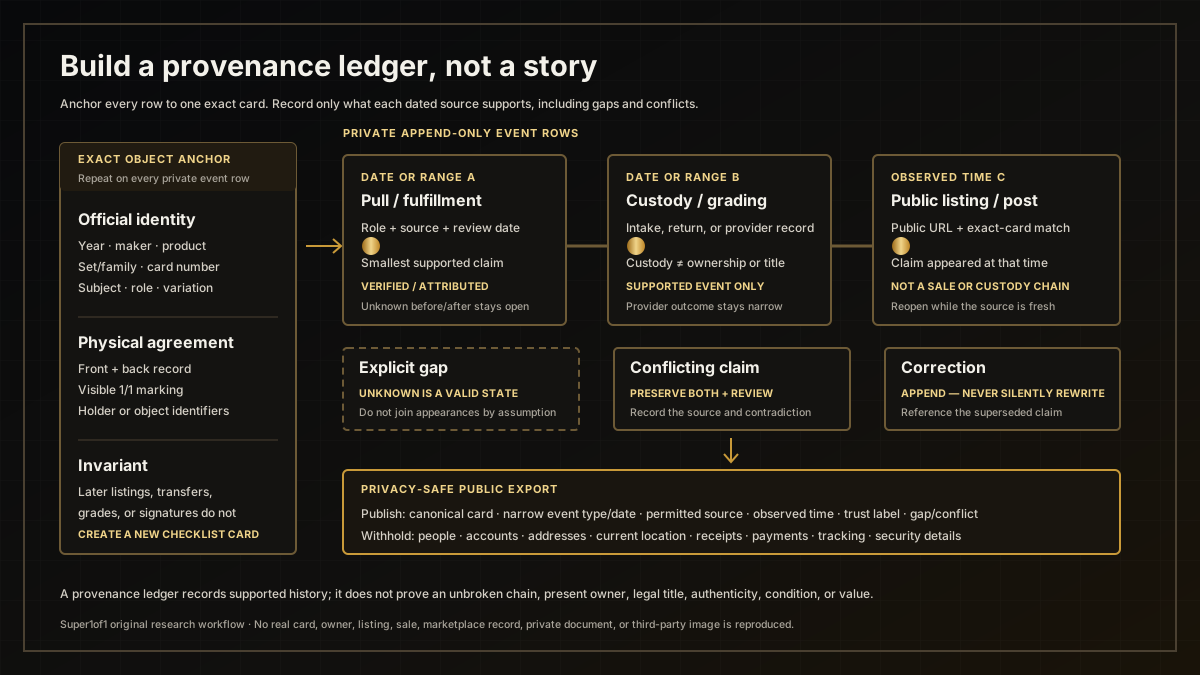
Repeat the exact object anchor on every private row, then record each pull, fulfillment, custody, grading, transfer, public appearance, physical change, dispute, or correction as its own dated event. Never bridge an unknown interval because the card is a one-of-one, and never let a later event rewrite the official checklist identity. A public copy should expose only the narrow card fact, permitted source, review time, and trust state needed to explain the event.
Match event types to evidence
| Event | Useful evidence | Safe conclusion |
|---|---|---|
| Pull or redemption fulfillment | Original front-and-back media, product context, dated receipt or account record kept privately, and a permitted independent break source when available | The card or completed redemption was observed in that context; later custody remains separate. |
| Public listing or post | Original public URL, publisher, observed time, exact-card match, and current source state | An accepted source records a public sighting at that time. It is not a custody chain or proof of sale; controlled listing fields are scrubbed after expiry while generic sighting facts remain. |
| Grading or reholder | Provider certificate page, holder label, available provider image, submission or return record kept privately, and physical consistency | The provider recorded its stated service outcome for the submitted object. PSA's certificate lookup warns that number verification alone does not eliminate risk. |
| Sale, gift, inheritance, or trade | Governing transaction or transfer record, parties' roles, event date, and object identifiers | A transfer can be recorded to the extent the documents support it; price, title, taxes, and disclosure rights remain separate questions. |
| Consignment, loan, vault, grading, or shipping custody | Intake, tracking, inventory, handoff, return, or receipt record kept privately | Physical custody changed or was claimed to change; custody does not automatically mean ownership. |
| Signature, alteration, damage, repair, or correction | Before-and-after files, provider or witness record, date, and precise physical change | The existing physical card changed or its description was corrected; the canonical checklist identity remains unchanged unless official product evidence says otherwise. |
Unknown is a valid provenance state
Do not connect two public appearances merely because the card identity is unique. Record “publicly observed on this date; custody before and after unknown” when that is all the source supports. A 1/1 print run narrows the intended checklist copy, but repeated titles, copied images, relistings, stale pages, certificate reuse, and private transfers can still make two claims conflict.
Keep corrections append-only. Add the new event, identify the superseded claim, cite the reason, and retain the earlier wording in the private revision record. Do not silently replace a disputed seller, sale, grade, date, or owner claim with a cleaner story.
Keep the detailed ledger private
| Usually safe for a public evidence timeline | Keep private by default |
|---|---|
| Canonical card title and Super1of1 URL | Collector, buyer, seller, consignor, witness, or recipient identity without permission |
| Narrow event type and date supported by a permitted source | Home, storage, return, event, or delivery address and precise current location |
| Source publisher, public URL, observed date, and trust label | Receipt, invoice, payment, tax, insurance, account, support, tracking, and redemption details |
| Visible identity or condition fact needed to explain the event | Private messages, signatures used for authorization, full legal documents, and unrelated people |
| Explicit gap, conflict, withdrawal, or correction | Security procedures, vault identifiers, access schedules, and unpublished collection inventory |
Eight-step Superfractor provenance workflow
- Resolve the exact identity first. Use the Superfractor identity worksheet and the official Topps checklist library with the applicable official odds or product documentation.
- Freeze the present physical record. Use the evidence-photo checklist without unnecessary handling, then retain the originals privately.
- Create one chronological row per event. Do not merge a pull, listing, sale, grading result, custody handoff, and later post into one sentence.
- Attach sources narrowly. Note what each source says, when it was reviewed, whether it is independent, and whether you may share it.
- Separate roles. Identify owner, custodian, seller, consignor, publisher, grader, or witness only to the level the evidence and permission allow.
- Mark gaps and conflicts. Use explicit unknown ranges and preserve competing claims for review.
- Make a privacy-safe public copy. Remove personal, account, transaction, security, and location data before submitting a narrow source.
- Append future events. Add dated changes and corrections without rewriting the earlier record. For marketplace sources, retain normalized sighting facts after controlled listing fields expire.
Reusable private Superfractor provenance ledger
Use one event block per row or note. Keep the detailed file under your control and publish only a necessary, permitted source.
Canonical card URL or proposed exact identity:
Card number / subject / autograph, relic, variation, or holder identifiers:
Physical 1/1 and front/back record retained:

Event date or bounded range:
Event type:
Participant roles / private identities stored separately:
Custody state before / after:
Ownership or transfer claim, if separately documented:
Source publisher / URL or private record identifier:
Source publication date / observed date / review date:
Smallest supported claim:
Verified / attributed / inferred / conflicting / unresolved:
Reason and source for any inference:
Sharing permission / rights boundary:
Private fields excluded from publication:
Conflicts with another event:
Correction, withdrawal, or superseded-claim reference:
Gap before / after this event:
Next review action:
How Super1of1 uses provenance evidence
Super1of1 records accepted public sightings from reviewed independent sources and fresh official marketplace APIs. Exact matches contribute to canonical seen coverage; unmatched accepted items remain provisional observed cards. Marketplace expiry scrubs controlled listing fields while generic normalized sighting facts and reviewed relationships remain. No sighting creates an official checklist identity or proves a sale.
The public timeline documents supported card events, not a complete owner registry. It does not verify legal ownership, present possession, authority to sell, current location, authenticity, condition, price, or an unbroken chain. Use the public-evidence guide before turning a gap into an “unpulled” claim and the census methodology for canonical publication and evidence rules.
Source review and Super1of1 boundaries
This guide was reviewed against the Smithsonian, Getty, Topps, and PSA pages linked above on 2026-07-16. It adapts general provenance-recording principles to a narrow Superfractor research workflow; it does not reproduce a third-party registry, checklist, image, marketplace payload, private transaction, or owner list.
Super1of1 does not authenticate cards, verify legal title or private ownership, take custody, register transfers, provide escrow, preserve third-party content, appraise value, arrange insurance, or provide legal, tax, insurance, investment, storage, shipping, buying, or selling advice. The canonical census remains limited to true Topps and Bowman baseball Superfractors from 2024 onward.