Can One Player Have Multiple Superfractors? Base vs. Auto
Separate a player’s base, autograph, 1st Bowman, rookie, patch, insert, and variation Superfractor or 1/1 identities, including Topps Three Kings.
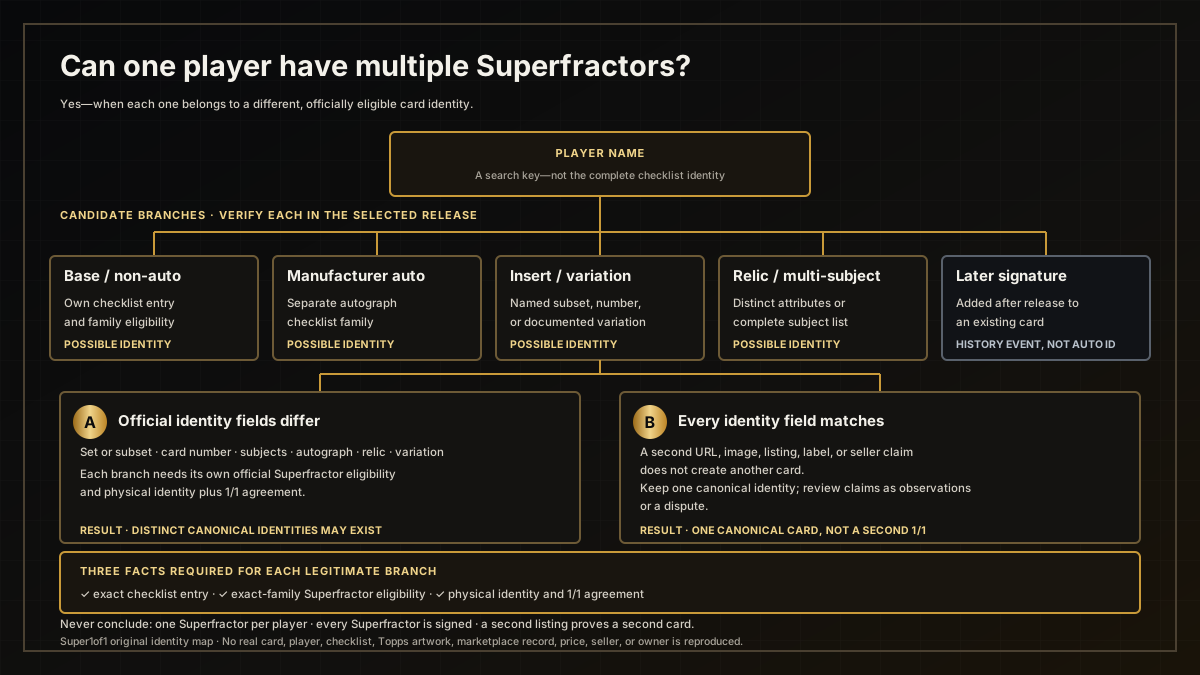
Yes. One player can have several legitimate Superfractor 1/1 cards in the same product because the one-copy print run belongs to each exact card identity—not to the player as a whole. A base card, autograph, insert, image variation, relic, or multi-subject card can be a separate identity, but only when the official checklist and product documentation support that exact family.
Quick answer
“One of one” means one copy of a particular card identity. It does not mean one Superfractor for the player's entire product appearance, season, or career. Compare the year, product, set or subset, card number, subject combination, autograph or relic state, variation, and eligible parallel family. If an identity-changing field differs, the cards may each have their own legitimate Superfractor. If every field is the same, two public claims describe one canonical card until evidence resolves the physical objects.
One player, separate identity branches
A player name is a useful search key, not a complete card identity. Start separate candidate branches for base or non-autograph cards, manufacturer autograph cards, inserts or documented variations, and relic or multi-subject cards. Require an exact checklist entry, exact-family Superfractor eligibility, and physical identity and 1/1 agreement on every branch. A signature added after release stays a later history event on the original card rather than creating a manufacturer autograph identity.
Are all Superfractors autographed?
No. Superfractor names the one-of-one parallel for an eligible card identity; autograph is a separate manufacturer attribute. A release can give Superfractor eligibility to a non-autograph base or insert family, an autograph family, both, or neither. The exact checklist and applicable official product documentation must establish each family separately.
| Physical or checklist claim | Working classification | What must be verified |
|---|---|---|
| Eligible base or non-autograph insert with a 1/1 Superfractor parallel | Non-autograph Superfractor identity | The exact checklist entry and that non-autograph family's Superfractor eligibility. |
| Eligible manufacturer autograph family with a 1/1 Superfractor parallel | Autograph Superfractor identity | The autograph checklist entry, card number, subject, and that family's own eligibility. |
| The same player appears in eligible base and autograph families | Two distinct Superfractor identities | The player must actually appear in both exact checklist families; one appearance cannot be inferred from the other. |
| A signature is added to a non-autograph Superfractor after release | The original identity with a later physical-history event | A post-release signature does not convert the card into a manufacturer-issued Autograph Superfractor. |
| An autographed printing plate or other 1/1 | Autographed one-of-one; not a Superfractor unless official sources name that exact parallel | Neither the autograph nor the 1/1 marking supplies the Superfractor name. |
“Given card” is the controlling boundary
Topps's official Superfractor definition says that for any given card there is only one Superfractor of that card in the product. The unit is the card, not the featured player. Topps's checklist definition on the same glossary describes a product checklist as including base cards, parallels, autographs, and other entries, which is why the complete checklist identity must be resolved before applying the one-copy rule.
| Two claims differ by | Identity result | What must be verified |
|---|---|---|
| Base versus manufacturer autograph | Usually separate card identities | Each checklist entry and each family's Superfractor eligibility. |
| Base versus named insert | Separate identities | The insert checklist, card number, and its own parallel structure. |
| Standard image versus official image variation | Separate only when the release documents the variation as its own eligible identity | The exact variation identifier and family-level Superfractor eligibility. |
| Solo card versus dual- or multi-subject card | Separate identities | The complete subject combination, set or subset, and card number. |
| Non-relic versus relic or autograph-relic | Separate identities | The checklist family and applicable official product documentation. |
| Manufacturer autograph versus a signature added after release | Not automatically separate | A later signature is a physical-history event on the original card unless the manufacturer issued a distinct autograph checklist identity. |
| Two listings with every identity field equal | One canonical identity with multiple public sightings | Compare images and serial details; concrete duplicate-object conflicts route to review instead of creating another checklist identity. |
| Superfractor versus printing plate 1/1 | Separate objects, but only one is a Superfractor | The exact official parallel name; a 1/1 stamp alone does not make a printing plate a Superfractor. |
Base versus autograph Superfractors
Topps's True Refractor definition expressly discusses Refractor parallels of a base card or a base autograph. In a product where official sources give both families a Superfractor 1/1, a player's base Superfractor and autograph Superfractor are two different one-of-ones. They can use a related design or the same subject without sharing a canonical identity.
The distinction is visible in Topps's 2025 Topps Chrome Baseball product breakdown. It lists Superfractor 1/1 parallels within multiple insert families and then separately lists Chrome Rookie Autographs and other autograph families with their own Superfractor 1/1 parallels. That page demonstrates the family structure; it does not establish that a particular player appears in every family.
What is Topps Three Kings, and are all three grail cards Superfractors?
No. As reviewed on 2026-07-16, the official Topps Three Kings program page and terms require one collector to assemble three different grail-card types for the same eligible athlete: a Rookie Debut Patch Autograph or Rookie Premier Patch Autograph, a Bowman Chrome 1st Superfractor Auto, and a Topps Chrome Rookie Superfractor Auto. The program names the latter two as Superfractor autos. It does not turn the patch autograph into a Superfractor or merge the three cards into one identity.
| Three Kings record | Exact identity treatment | Official check | What it does not prove |
|---|---|---|---|
| Rookie Debut Patch Auto or Rookie Premier Patch Auto | A separate manufacturer-issued patch-autograph 1/1 required by the program | Exact athlete, release, product, set, card number, and the program's current eligibility wording. | That the card is a Superfractor, a Bowman 1st, or a Topps Chrome Rookie Superfractor Auto. |
| Bowman Chrome 1st Superfractor Auto | One exact prospect-era autograph Superfractor identity | The 1st designation, autograph checklist entry, card number, official Superfractor eligibility, and physical 1/1 agreement. | That a related non-autograph, later prospect, rookie, or insert card can substitute. |
| Topps Chrome Rookie Superfractor Auto | One exact rookie-era autograph Superfractor identity | The rookie designation, autograph checklist entry, card number, official Superfractor eligibility, and physical 1/1 agreement. | That the Bowman card, patch autograph, or another Topps Chrome Superfractor is interchangeable. |
| Three Kings reward card | A separate post-verification 1-of-1 reward card, not one of the three input grails | The current program terms, Topps's verification, and the exact reward description issued for the athlete. | A pack-issued checklist identity, an additional census Superfractor, a guaranteed autograph or inscription, or a claim that remains available. |
Does completing Three Kings create another Superfractor?
The current official page calls the output a unique 1-of-1 Three Kings card and collectible. In the reviewed wording, Topps does not call that reward a pack-issued Superfractor. Super1of1 therefore does not add a Three Kings reward to its canonical census merely because it is unique, gold-toned, autographed, described as a grail, or called a Superfractor by a marketplace or secondary article. The exact official reward identity would have to satisfy the same named-parallel and census-scope rules as any other candidate.
Verify program availability before acquiring cards
Owning three matching cards does not prove that a reward remains open. The current Topps page says each athlete's reward can be claimed only once, warns that its public tracker may not update immediately, and directs collectors to confirm availability through current official support before acquiring grail cards for the program. Its terms also make card existence, collector eligibility, sole ownership and control, the claim period, authentication, and program status separate gates that can change.
| Program gate | Private record to prepare | Safe result |
|---|---|---|
| All three required card types exist | Three exact release and checklist identities with direct official sources; do not use a player name or seller bundle as the join key. | Existence is unresolved until every required identity is documented for that athlete. |
| Reward availability | Dated observation of the official tracker plus a dated current-support confirmation before a consequential purchase or claim. | A blank or open-looking tracker row is not a guarantee; a claimed reward does not reset when the cards transfer. |
| Card identity and authenticity | Complete front, back, 1/1, autograph, patch, card-number, checklist, and eligibility records retained privately. | Super1of1's census or a marketplace observation does not replace Topps's validation. |
| Collector and custody eligibility | Review the current terms for the individual collector, ownership, possession or control, loan, consignment, group, and continuous-control requirements. | A watch, listing, shared purchase, loan, custody record, or public claim does not establish program eligibility. |
| Claim window | Exact RDPA or RPPA release-date evidence, the current deadline rule, and the collector's working calculation. | The worksheet cannot determine a binding deadline; current Topps terms and Topps's decision control. |
| Verification and fulfillment | Use only the current official claim route and keep identity, provenance, purchase, account, and delivery records private. | No reward, autograph, inscription, delivery method, insurance treatment, tax result, or successful claim is guaranteed by this guide. |
Blank Topps Three Kings eligibility worksheet
Use one row per required grail to keep identity, official source review, program availability, private ownership checks, claim timing, and unresolved conflicts separate. The blank CSV downloads directly to your device; Super1of1 does not receive, upload, or store what you add.
Download the blank Three Kings CSV
Do not enter an owner name, government ID, account credential, email address, home or vault location, purchase amount, payment record, proof-of-purchase image, private message, claim identifier, or delivery detail. Keep sensitive documents in your own appropriately secured system and record only a private reference when necessary.
Do not transfer an example across products or years
A family documented for one release does not prove that the same family exists or is Superfractor-eligible in another release. The official Topps checklist library establishes the exact entries for the selected product. The official Topps pack-odds library or comparable official product documentation establishes which of those families receive the Superfractor parallel. Both sources must agree before a canonical identity is published.
For Bowman, the official Bowman Chrome Baseball page describes 1st Chrome Prospects and Chrome Prospect Autographs as separate chases. Topps's 2025 Bowman Baseball guide then documents a 1-of-1 Superfractor endpoint for Chrome Prospect Autographs. A player name appearing in both places remains only a candidate until the exact product checklist and all applicable parallel sources are reconciled.
Eight-field exact-identity test
- Freeze the release. Record the year, manufacturer, brand, product, edition, and applicable configuration.
- Name the set or subset. Do not collapse a base set, insert, autograph set, or relic set because the subject matches.
- Transcribe the card number. Preserve prefixes, suffixes, and variation codes instead of normalizing them away.
- Record every subject. A solo card and a multi-subject card are not the same identity.
- Separate manufacturer attributes. Record autograph, relic, rookie, prospect, image variation, and other identity-changing states exactly as supported.
- Verify family eligibility. Require official product documentation naming a Superfractor for that exact family and configuration.
- Check the physical claim. Confirm the 1/1 marking and front-and-back details without treating appearance as a substitute for product sources.
- Separate sightings from checklist identity. Store accepted listings and submissions as dated public sightings while expiring provider-controlled listing details; never create another canonical card because a second URL or image appears.
When two apparent Superfractors conflict
First compare the complete identity fields. If the cards differ by an official card number, set or subset, subject combination, autograph or relic state, variation, or eligible family, they may be two legitimate Superfractor identities. If those fields are identical, every qualifying listing still counts as a public sighting, while concrete signs of distinct conflicting physical objects route to disputed review. Multiple listings do not create another checklist identity by themselves.
Reusable multiple-Superfractor comparison note
Use one column per claim. Keep private ownership and transaction data out of the public record.
Release year / manufacturer / brand / product / edition / configuration:

Field | Claim A | Claim B | Same or different | Official source
Set or subset:
Card number, including prefix or suffix:
Complete subject list:
Base, autograph, insert, relic, or variation family:
Rookie, prospect, image, inscription, or other attributes:
Official checklist entry:
Official Superfractor eligibility:
Physical 1/1 and front/back details:
Independent evidence source and observed date:

Working result: distinct canonical identities / same identity with multiple observations / disputed / unresolved
Reason:
Source URLs / versions / reviewed dates:
Private details excluded from publication:
Download the blank comparison CSV
The CSV has one row per claim and separate source-review fields. It downloads directly to your device; Super1of1 does not receive, upload, or store what you enter.
Source review and Super1of1 boundaries
This guide was reviewed against manufacturer-published pages available on 2026-07-16, including the live Topps Three Kings program terms. It records a comparison method and direct source links, not copied checklists, odds documents, card images, marketplace payloads, program tracker data, player inventories, prices, or ownership claims. Product and program terms change; reopen the exact release sources and complete official terms before classifying a card, acquiring it for a program, or attempting a claim.
Use the 1st Bowman identity guide for prospect-versus-rookie terminology, the general identity worksheet for physical and source agreement, the private provenance workflow for ownership and custody records, and the public-evidence guide before describing whether a copy has surfaced. Super1of1 is independent of Topps and does not authenticate cards, determine Three Kings eligibility or availability, calculate a binding deadline, submit or broker a claim, contact an owner, decide which card to acquire, appraise cards, verify ownership, or expand its canonical census beyond true Topps and Bowman baseball Superfractors from 2024 onward. The broader Three Kings program currently references other sports, but those cards remain outside this baseball census.